
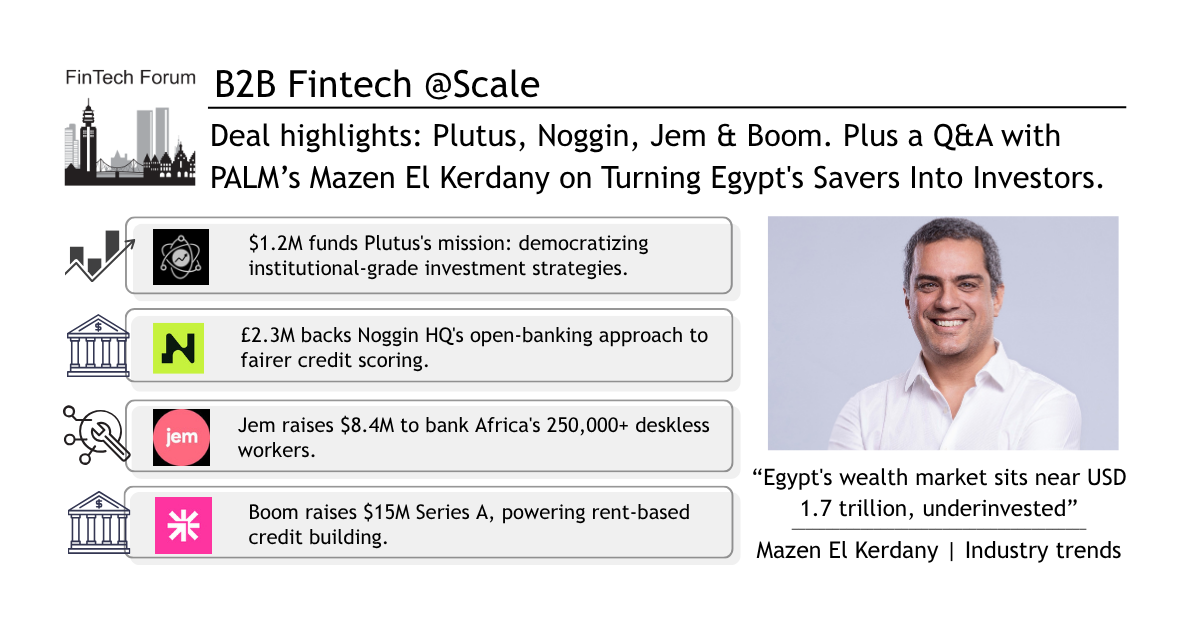
This week, we’re tracking the builders turning fragmented finance into something more connected. Samarth Shekhar opens with four B2B plays worth watching: Plutus, Noggin HQ, Jem, and Boom, each unlocking a customer segment banks and insurers have struggled to serve profitably.
Frank Schwab then looks at where banking is headed next, arguing that with 4.7 billion people now on social media, the future of financial services lives inside the feed, not beside it. Our Q&A of the week takes us to Cairo, where Mazen El Kerdany of PALM is building the rails to turn Egypt’s savers into investors. And as always, we close with the week’s funding highlights, the capital moving into the founders and ideas shaping what comes next for fintech. Read on.
A Q&A with Mazen El Kerdany from PALM on Turning Egypt’s Savers Into Investors

Egypt’s wealth is enormous and almost entirely misplaced: of a market worth roughly USD 1.7 trillion, an estimated 84% sits in real estate and gold, only 15% in bank deposits, and a mere 1% in actual investments. It’s a gap that co-founders Mazen El Kerdany and Ahmed Ashour set out to close when they launched PALM in 2024.
El Kerdany spent two decades in asset management across Cairo and Dubai, managing USD 2 billion in mandates for institutions and HNWIs before deciding that the discipline built for the wealthy belonged to everyone else too. Ashour brought the product and tech muscle, honed at Amazon, Johnson & Johnson, and Goldman Sachs, before returning home to Egypt in 2022.
Together they built a goal-based saving and investment platform, licensed by Egypt’s FRA, that ties every pound saved to a real-life purpose, whether that’s a wedding, a car, or simply the discipline of not watching inflation quietly erode a bank balance. We sat down with Mazen to talk about serving Egypt’s 28 million banked-but-underserved savers, the mechanics of turning spending into investing, and why he thinks Egypt today looks a lot like the US in the 1980s.
1. Tell us about yourself / your co-founder(s).
I’m Mazen, co-founder and CEO of PALM. I’ve worked in asset management since 2004, at regional houses including EFG Hermes and Beltone, living and working in Cairo and Dubai, where I managed USD 2 billion in mandates for institutions and high-net-worth individuals. Later in my career I moved to the corporate strategy side, leading the transformation of a classic investment bank into a fully-fledged financial services company, and refocusing a public investment company around a sharper mandate aligned with its mission. The idea behind PALM followed me through that whole career: everything we built for institutions and HNWIs (professional management, discipline, strategies matched to objectives) was exactly what ordinary people needed most, and had no access to.
I joined hands with Ahmed Ashour, co-founder and CBO, who brings product, tech, and finance experience from Amazon, Johnson & Johnson, and Goldman Sachs. Ahmed has lived in Cairo, Luxembourg, New York, and Seattle. He worked across both financial services and consumer products building new business lines like Amazon marketplace for more than 8 years and corporate development, supported deals throughout his tenure in Goldman Sachs IB division focusing on biotechnology and TMT sectors before returning to Egypt in 2022.
Together, we have gathered a founding team from the different walks of life that matter for PALM: asset management, banking, FMCG, and fintech.
Read more from the interview: PALM on Unlocking Goal-Based Savings and Wealth Creation in Emerging Markets
B2B FinTech @Scale Deal Highlights: Plutus, Noggin, Jem & Boom.
Samarth Shekhar highlights startups that can help scale financial services by unlocking new customer segments or product offerings via B2B partnerships.
Plutus can enable a retail bank or brokerage offer its retail/ mass affluent customers access professionally managed, hedge fund style thematic portfolios that replicate automatically inside the customer’s own brokerage account. For a bank with a self-directed investing platform that is losing customers to independent research providers and Substack stock-pickers, Plutus can bundle curated model portfolios with automated rebalancing and tax-loss harvesting as a subscription tier. This can create new revenues from subscription fees or AuM-based fees from mass affluent clients who want more than an index fund but can’t afford a private wealth manager.
Noggin HQ is an FCA-authorised credit reference agency delivering cashflow-based, open-banking credit data, which means a bank can lend profitably to the 3.2 million UK adults its traditional bureau data currently forces it to decline. This expands the market by adding thin-file borrowers, renters, recent immigrants, and gig workers who are creditworthy on real-time affordability data but invisible to backward-looking scores. A bank can plug in Noggin’s data and expand the approvable population without lowering risk standards, and assess based on what a borrower can actually afford today, converting rejected applications into performing loans.
Jem is the B2B2X distribution rail via WhatsApp into a population that banks and insurers structurally cannot reach directly: the 250,000+ deskless workers across e.g. retail, security, hospitality, manufacturing who have no work email and no easy banking relationship. For a corporate employer, Jem is a retention and ethical employment tool bundling earned-wage access, payslips, and benefits. For banks or insurers, Jem can be a channel for offering earned-wage access, helping build up credit scores that moves thin-file workers to bankable customers, with near zero CAC via the employer relationship.
There are over 100 million American renters, but they are served poorly by traditional credit, lending and insurance players. Boom turns on-time rent payments, often a renter’s largest monthly expense, into reported credit history, and turns it into a full leasing and underwriting operating system covering 500,000+ units. For a bank, the rent payment data can power mortgage underwriting, letting the bank qualify first-time buyers who were previously invisible. The credit building product can build a pipeline of younger, thin-file renters who graduate into mortgage and deposit customers or renters’ and landlords’ insurance embedded at lease signing.
Read on for more on the founders and investors in the news last week. If you are building or backing “what’s next in finance” and want to spread the word with our network of 20K+, reach out to Samarth Shekhar or Frank Schwab.
By 2023, more than 4.7 billion people used social media—over half the global population.
by Frank Schwab
For banks, this is not merely another digital channel; it is a shift in where attention, trust, engagement, and financial decisions are formed. The traditional model relied on media gatekeepers, while platforms now allow individuals, communities, creators, and brands to reach global audiences directly and bring banking into the feed. The opportunity is to combine real-time service, chatbots, social payments, and embedded finance so that financial services become part of the customer’s existing interactions.
Read more: https://www.linkedin.com/feed/update/urn:li:activity:7496446098866216960/
VENTURE FINANCING
Plutus raises to bring hedge-fund-grade portfolios to everyday investors
Plutus, a Kirkland, Washington-based fintech founded in 2025, is building an investment marketplace that gives everyday investors access to strategies traditionally reserved for hedge funds and ultra-wealthy clients. The platform acts as an advisory marketplace between individual investors and independent research providers such as Citrini Research: users browse curated, thematic portfolios, select one that fits their goals, and replicate it automatically in their own brokerage accounts. Unlike passive ETFs or mutual funds, the portfolios are designed for automated rebalancing and potential tax advantages, including tax-loss harvesting optimized for the S&P 500. Plutus takes a cut of the subscription fees set by each portfolio provider. The company offers professionally curated, automated model portfolios that replicate institutional trading strategies with full transparency and seamless execution in the customer’s own brokerage account. Backed by Rocketship.vc, Plutus is expanding its roster of independent research providers and model-portfolio strategies.
Noggin HQ raises £2.3m in seed round and receives FCA credit referencing authorisation
Newcastle-based fintech Noggin HQ has launched its alternative credit scoring technology to UK lenders after raising £2.3 million in an oversubscribed seed round, led by Blackfinch Ventures with continued participation from Oxford Capital, Bethnal Green Ventures and several domain-specific angel investors. The raise comes as the business successfully obtains its credit referencing authorisation from the Financial Conduct Authority (FCA), meaning it can now provide its cashflow-based credit data to FCA-authorised lenders. This makes it one of only a handful of companies to obtain a license to become a credit reference agency in the UK in the last 10 years. With 3.2 million UK adults declined credit in the two years to May 2024, Noggin HQ uses permissioned banking transaction data to help lenders identify creditworthy customers traditional systems miss. Childhood friends Evangeline Atkinson and Laura Mills founded the company after they were declined for credit despite being in full-time work and paying rent and bills. The investment will support Noggin HQ as it moves from successful pilots into wider market adoption. Angel investor Alastair Douglas, former CEO of TotallyMoney: “Credit scoring is broken because it only looks backwards, judging people on a patchy record of their past. Open Banking turns that on its head: real-time data that shows what people can actually afford.”
Jem raises $8.4M Series A to grow AI workforce platform across Africa
Jem, the WhatsApp-based workforce management platform for deskless teams, has raised $8.4 million (135 million ZAR) in a Series A round led by US-based fintech investor Quona Capital, with participation from University Tech Fund, E4E, Next176/FutureGrowth, and angel investors including former Old Mutual CEO Iain Williamson. Founded in 2020 as SmartWage and rebranded as Jem in 2022, the company started by letting employees access earned wages via WhatsApp, and has since built a wider suite covering payslips, document management, onboarding, time and attendance, leave, and workforce communication. Three out of four employed South Africans work on the front line, not at a desk — waiters, farm and factory workers, security guards — and have typically been locked out by technology providers, with no laptop, no work email, and no reliable way to stay connected to their employer. Jem serves more than 250,000 employees across over 200 companies, including McDonald’s, KFC, Bidvest, Servest, Seattle Coffee Company and Bootleggers, and has grown revenue more than 120% over the past year with almost zero churn. The new funding will extend the platform into rostering, employee assistance programmes, and credit scores. Co-founder and CEO Simon Ellis: “Many employers still run their workforces on a patchwork of legacy systems, from earned-wage-access point solutions to workforce communication tools.”
Boom bags $15m Series A, unveils BoomCRM
Boom, the leasing operating system for property management, has raised $15m in a Series A funding round and used the announcement to launch BoomCRM, a new leasing tool built around underwriting intelligence. The round was led by S3 Ventures, with participation from Mischief VC (the fund of Plaid CEO Zach Perret), alongside continued backing from existing investors Starting Line VC, Gilgamesh Ventures and Company Ventures, bringing total funding to roughly $20.5m. Founded in 2020 by Rob Whiting (CEO) and Kirill Moizik (CTO), Boom began focused on rent reporting for consumers (BoomReport), enabling renters to build credit by reporting on-time rent payments to the major bureaus — typically their largest monthly expense. It expanded into FCRA-regulated tenant screening (BoomScreen) and now a full leasing operating system for single-family rental, scattered-site, and manufactured housing operators. Boom serves more than 400 property operators overseeing over 500,000 units, including AMH, Roots Management, and On Q Property Management, and integrates with property management systems including AppFolio, Yardi, Buildium, and Entrata. BoomCRM answers incoming calls, qualifies prospective tenants and arranges property tours — positioned as the first leasing CRM built from the ground up on underwriting data rather than having screening added later. The capital will fund expansion into multifamily and student housing.
Source: https://fintech.global/2026/08/19/boom-bags-15m-series-a-unveils-boomcrm/
Strands secures pre-seed for multi-asset tokenization infrastructure
Strands, a Chicago-based fintech founded in 2022, operates a holistic multi-asset execution platform designed for active traders and institutions who want a full-stack solution from Direct Market Access (DMA) execution up to a custom front end with full tokenization capabilities. The company specializes in direct market access, smart contract ecosystems, transactional gateways, and real-world asset tokenization, enabling traders and institutions to execute across traditional and on-chain venues with ultra-low latency and full-stack customization. Its Singularity front end lets clients trade multiple products, run algorithms, tokenize assets, manage risk, and perform fund administrative tasks on one platform, using Web3-native technology and the Strands Connect infrastructure to access both meta and physical venues at lower costs. In March 2026, Strands partnered with capital-markets platform Exegy to add real-time prediction-market, digital-asset, and smart-contract data to Exegy’s Axiom consolidated feed, and the platform is listed as a CME Group technology vendor. Total raised to date is approximately $6.5M across pre-seed rounds.
DeFi credit delegation protocol Twyne completes $2.5 million seed round
DeFi lending protocol Twyne secured $2.5 million in seed funding in a round co-led by Cyber Fund and Ethereal Ventures, with participation from Euler Labs, Daedalus, and several individual investors. Twyne provides a credit delegation layer that allows lending-market depositors to transfer unused borrowing capacity to other users in exchange for additional yield. Twyne argues that a large share of credit in venues like Aave remains idle with depositors who are not borrowing, while other participants face binding credit constraints. By making borrowing capacity delegable, Twyne aims to let depositors earn additional yield by delegating their unused credit while enabling borrowers to increase their effective liquidation thresholds and boost leverage. The protocol, incubated by Euler and built on Euler’s audited EVC/EVK stack, said it has recently surpassed $14 million in TVL. A core driver cited is Lido Finance’s EarnUSD vault, which the team says is able to double its leverage through Twyne on top of existing integrations with Aave, Pendle, Strata Markets and Ethena. Every position has two liquidation paths, with Twyne running its own liquidators so that creditors are always made whole.
Source: https://crypto.news/crypto-vc-funding-zerostack-secures-1b-ripple-raises/
Every week, this newsletter is a reminder that the future of finance is being built in increments: a license here, a partnership there, a founder deciding the old way of doing things isn’t good enough anymore.
From Cairo to Kirkland, from WhatsApp-based workforce tools to rent payments turned into credit history, the through-line is the same: access, extended to the people traditional finance left behind. Thank you for spending part of your week with us. We’ll be back next week with more of the deals, ideas, and conversations driving fintech forward.