
Every week, a new set of founders sets out to rebuild a corner of finance, and every week the network that follows them gets a little smarter.
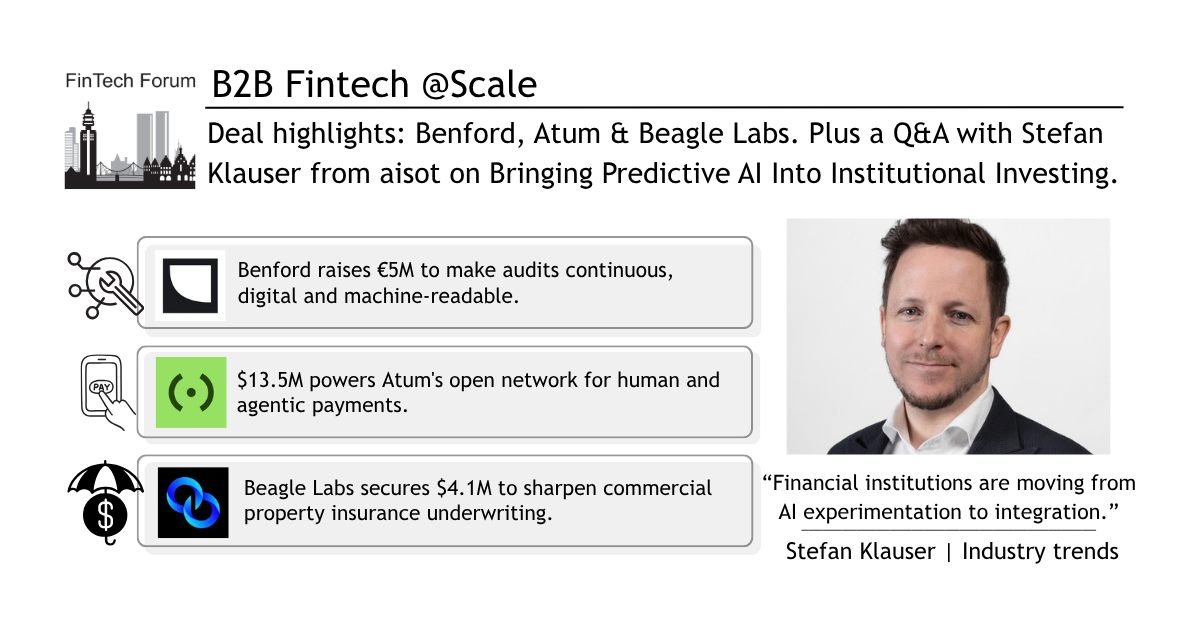
This edition brings that momentum into focus. In our B2B FinTech @Scale Deal Highlights, Samarth Shekhar spotlights three companies opening new paths for financial services: Benford, reinventing the audit; Atum, building an open network for global money movement; and Beagle Labs, bringing on-the-ground intelligence to property underwriting.
Frank Schwab then turns to the future of banking with a question every institution should be asking: what happens when customers choose the AI interface and the bank supplies the controlled access behind it?
Our Q&A of the week takes us to Zurich, where Stefan Klauser of aisot technologies explains how predictive AI can become a tool investment professionals genuinely trust, and why the human must always stay in control.
Finally, our Venture Financing roundup follows the founders and investors making headlines, from early-stage rounds to landmark Series B raises, the companies whose ambition guides and inspires the sector.
Settle in, and read on.
A Q&A with Stefan Klauser from aisot on Bringing Predictive AI Into Institutional Investing

Artificial intelligence is no longer just answering questions; it’s re-architecting how global capital is managed. Leading this shift is aisot technologies, an ETH Zurich spin-off transforming institutional investment management through predictive AI and agentic intelligence.
Founded by Stefan Klauser (CEO), Nino Antulov-Fantulin, and Tian Guo, and joined by CTO Roger Peyer, aisot bridges cutting-edge academic research with high-stakes financial engineering. Rather than replacing human judgment, their platform provides asset managers, private banks, and wealth institutions with a sophisticated predictive layer—turning massive datasets into real-time portfolio optimization without creating a black box.
We sat down with Stefan Klauser to discuss how aisot collaborated with ZKB to launch AI-supported Swiss equity products, why agentic AI is redefining governance in finance, and how their recent CHF 2 million funding round is accelerating their vision to make institutional investment processes truly intelligent.
1. Tell us about yourself / your co-founder(s).
I’m Stefan Klauser, CEO and Co-Founder of aisot technologies, an ETH Zurich spin-off focused on bringing predictive AI into institutional investment management.
I founded the company together with Nino Antulov-Fantulin and Tian Guo. Our roots are in complex systems, machine learning and quantitative finance, and the idea behind aisot grew out of research at ETH Zurich. Roger Peyer, our CTO, later joined the team, bringing experience from building wealth management solutions in the financial industry. Today, we combine that scientific background with a team spanning investment management, technology and financial services.
My own role has increasingly shifted towards translating what our technology can do into real applications for asset managers, banks and wealth managers and, importantly, making sure that AI becomes something investment professionals can actually use and trust rather than another black box.
Read more from the interview: Elevating Predictive Intelligence and Agentic AI in Wealth Management
B2B FinTech @Scale Deal Highlights: Benford, Atum & Beagle Labs.
Samarth Shekhar highlights startups that can help scale financial services by unlocking new customer segments or product offerings via B2B partnerships.
Benford operates as a fully licensed audit firm using its proprietary engine (AuditOS) to run statutory audits natively end-to-end. For commercial lenders, traditional SME credit underwriting relies on stale, manually compiled financial statements. Full-stack digital audit firms create machine-readable, continuous financial data feeds, enabling banks to underwrite SME loans faster and dynamically monitor credit risk.
Atum acts as a non-custodial coordination layer without issuing its own currency or running a proprietary blockchain. It uses a marketplace where settlement providers compete to fulfill payments, natively supporting protocol-level agentic transactions (such as x402 and MPP) where AI agents transact directly. Transaction banking departments risk losing fee revenues if autonomous software agents begin making purchasing decisions. Connecting to an open settlement layer could allow incumbent transaction banks to act as fulfillment providers for autonomous agent flows without building custom protocol rails.
Beagle Labs addresses the limitations of remote satellite/aerial property imaging by pairing AI signals with an on-demand network of 7,000+ field inspectors, reducing turnaround times to under 14 days. Commercial property insurers frequently suffer from mispriced risk and rework caused by incomplete remote data. Combining physical ground-truth inspection networks with AI underwriting prevents costly coverage blind spots in complex risk portfolios.
Read on for more on the founders and investors in the news last week. If you are building or backing “what’s next in finance” and want to spread the word with our network of 20K+, reach out to Samarth Shekhar or Frank Schwab.
Your Bank Can Keep the Account and Lose the Relationship
by Frank Schwab
Paywhere has announced commercial availability of a platform that lets banks and credit unions serve customers inside their existing AI tools.
The new channel brings banking into external workflows while, according to Paywhere, preserving the institution’s accounts, permissions and controls.
This extends the Revolut X pattern I covered in 3signals: customers choose the AI interface, while financial providers supply controlled access.
Read more: https://www.linkedin.com/feed/update/urn:li:activity:7488832069175840768/
VENTURE FINANCING
Steady lands fresh funding, names new CEO to push landlord insurance tools
Steady, which builds insurance compliance and risk management tools for single-family rental owners and property managers, has raised fresh funding; the company did not disclose the amount. The round came from Steady’s existing investors, including Nationwide. The insurer also backs Steady’s Owner Protect suite, which covers risks such as rent default, eviction, squatters, and excess pet damage. Alongside the raise, Steady named a new CEO: Collins, an early investor in Steady, takes the top job after technology leadership roles at Open Lending; Hwang, who joined Steady in 2023 from Goldman Sachs, also features in the leadership shift. Steady plans to launch Owner Launch in October, a platform for property managers to enrol landlord customers, offer insurance products, and manage subscriptions and renewals. The new capital and leadership are aimed at scaling those tools for the rental market. The signal: backing from an existing insurer and a founder-turned-CEO points to a bet on embedded insurance for the fragmented single-family rental sector — where landlords face growing risks and few tailored products.
Duqu raises €1.5M to give businesses faster access to working capital
Amsterdam-based fintech Duqu has raised €1.5 million in pre-seed funding from Curiosity VC and No Such Ventures. The company provides short-term advances against outstanding B2B invoices — funds arriving within 24 hours, often within an hour — without requiring businesses to sell their invoices or notify customers, distinguishing it from factoring. Founded October 2025 by Maas de Goede, Victor Brouwer and Diederik Nassenstein, Duqu has processed €4.6M+ in applications across ~1,500 users since launch. Alongside its financing platform, it has spent 18 months building a proprietary AI underwriting engine that automates ~95% of the credit-assessment process — offered modularly as a white-label solution to banks, lenders and leasing companies to assess applications under their own credit policies. Nearly half of B2B invoices in Western Europe are paid late. (PitchBook logs the line at $1.74M ≈ €1.5M.)
Titan — banking-native AI for financial institutions
Titan, a banking-native AI platform purpose-built for financial services, announced $3 million in funding led by Entropy Ventures (its Fund I inaugural investment). Launched from stealth in October 2025, Titan serves community, regional and super-regional banks, credit unions and fintechs that need AI infrastructure they can govern, audit and defend to examiners. Rather than adapting general-purpose LLMs, its models are trained on banking-specific language, data and workflows, delivering explainable, audit-ready outputs plus banking-specific agents through a secure private interface. The board includes former Acting Comptroller of the Currency Blake Paulson and operators from KeyCorp and Alliant Credit Union. CEO Arjun Sirrah says Titan tripled live ARR in seven months from a seven-figure base. This is the same AI-native banking-operations pattern as Maximum (last month).
Beagle Labs Announces $4.1 Million Pre-Seed Funding Round
NEW YORK, Sept. 22, 2026 (GLOBE NEWSWIRE) — Beagle Labs, an AI-enhanced property intelligence platform for complex commercial insurance underwriting, today announced a $4.1 million pre-seed investment round led by Chingona Ventures, plus Sovereign’s Capital, Remarkable Ventures, C2 Ventures, South Loop Ventures and Red Bike Capital. Beagle Labs’ platform gives insurance carriers and Managing General Agents and Underwriters (MGAs/MGUs) the ground-truth property and liability data remote modes can’t see. By turning property risk into real-time, actionable insight, Beagle Labs helps insurers and agents streamline underwriting and price risk accurately, delivering every property signal in one screen. Combining AI-enhanced inspections with on-demand coverage from more than 7,000 verified Beagle-equipped field inspectors nationwide, Beagle Labs turns in-field inspection orders around in 14 days or less, correctly, the first time. Traditional inspections routinely take 30 days or more, and come back with errors requiring re-work. “Time is money in the property insurance business and we are not only automating the intelligence of underwriting, but reducing the significant manual research today’s marketplace endures,” said Dwight Neptune, co-founder and CEO of Beagle Labs. “The lack of timely, actionable and accurate information creates blind spots that increase exposure to risk for property insurance carriers,” said Samara Hernandez, founding partner of Chingona Ventures. The company will use the funding to expand its technology platform, develop additional AI capabilities, strengthen customer support, and grow its team.
Mirai RiskTech raises €5M from Inveready to expand globally
MADRID, Spain – September 22, 2026 – Mirai RiskTech (“Mirai”), a risk technology company specializing in integrated asset and liability management (ALM) and balance sheet management, has closed a €5 million funding round with Spanish investment firm Inveready. The capital will accelerate Mirai’s growth across Europe, the United Kingdom, the United States and the Middle East, strengthen its presence in core markets such as Spain, and fund continued development of its AI-driven balance sheet management platform for banks. The investment comes as treasury and ALM teams operate amid faster markets, intensifying regulatory expectations and compressed timelines. “Banks have historically managed treasury, ALM, risk and finance on separate systems, which makes it harder for a chief financial officer and a chief risk officer to work from the same numbers,” said Olmo Vázquez, Chief Executive Officer and Co-founder of Mirai. “Mirai combines deep risk and ALM expertise with an AI platform that closes a real gap for banks navigating an increasingly complex regulatory environment.” Founded in 2013, Mirai unifies interest rate risk in the banking book (IRRBB), liquidity, funds transfer pricing (FTP) and regulatory reporting within one framework, serving more than 30 financial institutions across more than 10 countries. Part of the funding will advance Mirai AI, which combines generative AI and deep learning to help banks steer the balance sheet faster; Mirai AI Modeling lets banks create and deploy behavioural models using years of historical data, running statistical and machine learning methods within live production workflows.
Source: https://mirairisktech.com/press-center/mirai-risktech-raises-5m-from-inveready-to-expand-globally
Benford raises €5M to rebuild financial audit from the ground up
Fintech Benford announced today that it raised €5m in pre-seed funding to build a new-generation, tech-native financial audit firm that runs statutory audits end to end, from clients’ systems to the signed opinion. Instead of selling software to auditors, Benford becomes the auditor. The round was led by firstminute capital, Global Founders Capital, Sondo, and the people who built the software the accounting profession runs on today: Peter ter Maaten (HSO), Arthur Waller and Quentin de Metz (Pennylane), Alexandre Prot (Qonto), and the Spandow family (Amesto). Benford is a registered audit firm in Norway with its proprietary engine, AuditOS, live and running client audits today. AuditOS connects to the systems a company runs on — ERP, subledgers, invoices, banks and other operational systems — to collect and organise audit evidence, automating routine audit work while leaving key decisions and the signing of audit opinions to qualified auditors. The founders are Mads Bogen Øye, Thibault Mallion and Andreas Rystad, who have worked at Palantir, Goldman Sachs and One Peak. Benford is a team of twenty people, and the capital raised will grow the London and Oslo offices and take the firm into Sweden and further European markets. Benford is hiring across audit and engineering to build the audit firm of the next decade. The company sees the opportunity in the small- and mid-sized segment of Europe’s ~€50bn audit market, where the Big Four and large consolidators are shifting focus away.
Source: https://tech.eu/2026/09/22/benford-raises-eur5m-to-rebuild-financial-audit-from-the-ground-up/
MeshWallet Closes $10 Million Private Funding Round to Expand Gasless USDT Wallet
MeshWallet, a gasless USDT wallet serving users of the TRON network, has closed a $10,000,000 private funding round led by a core group of private investors and small family offices. Based in Tallinn, Estonia, the self-custodial wallet operates on TRON (TRC20) and lets users pay transaction fees directly in USDT, eliminating the need to hold TRX — simplifying the dual-token workflow for both retail and business users running frequent stablecoin payments. TRON remains the largest network by USDT transfer volume (Messari reported $2.1 trillion in Q2 2026). Proceeds fund product roadmap and user-ecosystem growth; the company said two independent security audits are underway. The wallet is live on both major app stores.
Monetary Metals Raises $10.5 Million in Latest Equity Financing
Monetary Metals, a Scottsdale, Arizona company operating the Gold Yield Marketplace, has raised $10.5 million in equity financing, exceeding its $10 million target with participation from existing shareholders and strategic investors; total funding reaches nearly $25 million. Founded in 2012 by Keith Weiner, it lets gold owners earn a yield on their metal by leasing it to precious-metals businesses — jewellers, refiners, mints, miners — to finance inventory, with returns paid in gold rather than currency. Gold deployed through the platform has more than doubled year over year. For wealth managers, the raise underscores rising interest in yield-generating structures around physical gold as a fixed-income complement.
givestar raises $12m to scale the technology powering modern fundraising (PitchBook line $17.2M)
givestar, a London-based next-gen fundraising technology platform, has raised $12 million in a Series A led by Mercia Ventures, with Benefact Group and Love Ventures participating. Nearly 800,000 user accounts have been created, helping raise more than $70 million from millions of donors for over 4,000 charities. The platform supports digital and event fundraising, supporter engagement and charity stewardship — products like Split Donate and Tap to Donate, plus a WhatsApp-based fundraiser stewardship system — helping charities acquire supporters and build longer-term relati…
Source: https://fundraising.co.uk/2026/09/29/givestar-raises-12-million-for-uk-growth-and-us-expansion/
Atum Emerges from Stealth with The Open Payments Network for Global Money Movement
Atum emerged from stealth having built an open payments network for global money movement, launching with $13.5 million from Variant, PayPal Ventures, Abstract Ventures, Road Capital, Mirana Ventures, First Commit, Credibly Neutral, and strategic advisor Charlie Songhurst. Atum connects payment companies, developers and enterprises through a single coordination layer — without issuing a currency, operating a blockchain, favouring a rail, or taking custody of funds — via a marketplace where settlement providers compete to fulfil each payment. It serves card issuers and acquirers, PSPs, card networks, stablecoin orchestrators, wallets, fintechs and enterprises, and supports both conventional stablecoin payments and agentic payments through protocols including x402 and MPP. Both humans and agents transact on Atum today.
iPiD Raises $16M as Instant Payments Expose a Growing Global Blind Spot
NEW YORK and SINGAPORE, Sept. 24, 2026 /PRNewswire/ — iPiD, the payment intelligence company helping institutions know who they are paying, announced a $16 million Series A led by Foundation Capital, with participation from strategic investors Citi and HSBC, alongside existing investors QED Investors, Monk’s Hill Ventures and Quona Capital. iPiD is a leading global provider of bank account verification, supporting major financial institutions across more than 50 countries, and provides decision intelligence for banks, PSPs, platforms and corporates moving money: across the payment lifecycle, iPiD helps them verify payees and assess fraud risk, meet regulatory obligations, monetise payments and enrich payment data. “Every payment starts with a decision, but institutions are often making that decision with incomplete information,” said Damien Dugauquier, co-founder and CEO of iPiD. “We started by solving bank account verification globally.” iPiD calls the category Know Your Payee (KYP): its Global Validate service supports cross-border account checks, while Node connects institutions to specific schemes such as the UK’s Confirmation of Payee and the European Union’s Verification of Payee framework — the European Payments Council’s VoP rulebook took effect on 20 September 2026, four days before the Series A was announced. The funding will deepen its network, accelerate growth in the United States and Europe, and support capabilities spanning U.S. payment systems, stablecoins and digital assets; Singapore-based Triple-A has already used iPiD for fiat and stablecoin transactions. The round follows a $5.3m pre-Series A in 2024, taking disclosed funding to roughly $21.3m.
Wealthcome raises €15M Series B to scale its wealth data and AI platform
Wealthcome, a wealth-management software provider based near Bordeaux, France, has raised €15 million (~$17.2 million) in a Series B led by Breega, with returning investor BlackFin Capital Partners participating; total funding reaches €22 million. Its WealthPro platform aggregates client wealth data, automates business workflows and structures compliance journeys for independent wealth advisers, family offices, private banks, insurers and other institutions — now 800 firms and 6,000 professional users overseeing €20bn+ in aggregated assets. The capital funds expansion with large institutional clients, stronger compliance capabilities, and a deeper AI ecosystem built into its tools, paired with requirements around data sovereignty and auditable advice. The firm aims to expand from advisory firms into banks, insurers and mutual funds.
Source: https://ventureburn.com/wealthcome-raises-15m-series-b/
Outmarket AI raises $34.5 million in SignalFire-led Series B
Outmarket AI, an AI platform for the insurance industry, has raised $34.5 million in a Series B funding round led by SignalFire. Fika Ventures, Permanent Capital Ventures, TTV Capital and Dash Fund also participated in the round. The funding follows Outmarket’s $17 million Series A round in May and brings the company’s total funding to $56.5 million, at a reported $335 million valuation. San Francisco-based Outmarket said it recently surpassed 10,000 active users as it expanded its team across engineering, insurance operations and customer success. The company’s platform connects directly with agency management systems to automate complex processes across commercial, benefits, personal lines and specialty insurance, supporting workflows including policy review, proposal generation, loss-run analysis, coverage-gap detection and carrier appetite search — positioned as an intelligence layer across the systems agencies already use rather than a replacement for their core software. Alongside the funding announcement, Outmarket introduced a new certificates workflow designed to automate certificate-of-insurance processing. The company plans to extend parts of the platform to insurance carriers later this year. “We didn’t set out to raise again this soon, but the industry told us what it wants,” said Vishal Sankhla, CEO and co-founder of Outmarket AI. Anshu Jain, CTO and co-founder, added: “The scale we’ve reached this year has allowed us to build increasingly powerful capabilities into the platform.”
HIFI raises $37M Series A to build the infrastructure for tokenized money
Today we’re announcing that HIFI has raised a $37 million Series A led by Left Lane Capital. Mo Afifi and I started HIFI in New York in 2022 to build that missing infrastructure. Companies use HIFI to create entirely new financial products using stablecoins and tokenized money. HIFI provides APIs designed to connect traditional bank rails with stablecoin settlement, and its infrastructure currently processes more than $7 billion in annualized volume across 87 countries. For payments, developers can pair HIFI’s stablecoin settlement with Visa Direct, including the stablecoin push-to-card payouts launched this month, and HIFI has integrated with the Circle Payments Network to give customers more ways to settle. The company participated in DTCC’s July production trades involving DTC-tokenized assets alongside firms including BlackRock, Goldman Sachs and Nasdaq — giving it a position between the blockchain layer and the financial institutions that ultimately need cash settlement, compliance and distribution. HIFI is registered as a money services business and works with existing banking partners rather than trying to replace them; Arival Bank uses it to power stablecoin payment experiences. “We’ll use this round in three ways. We plan to obtain additional regulatory licenses so that more of the stack runs under HIFI directly. And we’ll extend the product from payments into cards and capital markets, where the unsolved problems, particularly around custody and control, are both the hardest and the most valuable to solve,” the company said. The latest tranche of $27.3 million closed on September 3, with the rest from earlier closes reaching the $37 million total; no valuation was disclosed.
Confido Raises $55M Series B to Scale Its CPG AI Platform
Confido has raised $55 million in Series B funding led by Insight Partners, bringing total funding to $77 million, with participation from Trenches Capital, Watchfire, Barrel Ventures and returning investors Footwork and Y Combinator. Since 2022, Confido has become the system of record and action where a consumer packaged goods brand’s commercial and financial workflows run on the same set of data: cash application, deductions management, automated disputes, trade promotion management, sales forecasting, and demand and supply planning all read from the same customers, products, promotions, contracts and shipments. More than 250 brands — including OLIPOP and Tropicana — route over $30 billion in annual retail sales planning through the platform, and brands have saved hundreds of thousands through revenue recovery and improved sales forecasting. The company reported 5x year-over-year growth and a 5x increase in valuation since its Series A. CPG companies operate on razor-thin margins while managing finance, accounting and trade spend across disconnected legacy systems designed to record transactions rather than optimise them; Confido’s platform automates deduction resolution, trade spend tracking and forecasting while surfacing only decisions requiring human judgment. The Series B empowers Confido to run true agentic, zero-click workflows across the platform, expand into the food service sector, and hire across product, engineering and go-to-market.
mika raises €6m to make German tax advisers optional
mika, a Berlin-based vertical AI business building an alternative to the traditional tax firm, has secured €6m in seed funding led by pan-European investor Smedvig Ventures, with Wecken & Cie. participating and existing investors Keen Venture Partners and Dutch Founders Fund increasing their stakes. The company is not simply putting a digital layer on top of conventional tax advisory. Instead, it has designed accounting, tax and finance from scratch as an AI-native financial operating system for SMEs. At the core of mika is a proprietary AI-native general ledger built specifically for German accounting; the technology reads receipts and payments and uses different AI models depending on the task, combined with accounting rules and domain knowledge developed by mika. For small limited companies (GmbHs and UGs), mika takes over ongoing bookkeeping, VAT pre-returns, the Jahresabschluss and tax returns. Qualified accountants on staff review the output and take over when a case is too complex for automation; individual tax advice is not currently part of the offering, with mika instead working with licensed tax advisers from its network. mika founder and CEO Agnieszka Walorska said: “The moment you start a GmbH in Germany, you’re told you need a tax adviser. At mika, we use AI to tear down that barrier, so that your bank balance or the family you were born into no longer decides who gets to start a company.” mika grew from around 400 companies at the start of 2026 to more than 750, passed €1m in annual recurring revenue in July 2026, and reports monthly growth above 20%.
Source: https://fintech.global/2026/09/24/mika-raises-e6m-to-make-german-tax-advisers-optional/
MoonPay to Acquire North Capital in $60M Tokenization Deal (M&A)
MoonPay has agreed to acquire North Capital Investment Technology, a Midvale, Utah private-markets infrastructure provider, in an all-stock deal reported at more than $60 million, subject to regulatory approval. North Capital holds SEC registrations spanning broker-dealer, alternative trading system (PPEX ATS), transfer-agent and investment-adviser activities, and has processed $8.7bn+ in primary and secondary private-securities volume. The acquisition gives crypto-payments company MoonPay an existing, licensed securities-market stack rather than requiring it to build one — the regulatory foundation for its push into tokenized real-world assets. CEO Ivan Soto-Wright framed it as connecting different parts of the financial system through programmable infrastructure. Another “incumbent-capability” acquisition, crypto-native buying regulated rails.
Superstar Platforms Announces Agreement to Acquire TitlePal, Inc. (M&A, all-stock)
Superstar Platforms (OTCID: SPST), a holding company across fintech, automotive and technology-enabled commerce, has agreed to acquire TitlePal in an all-stock transaction. TitlePal runs a web- and mobile-based platform that moves vehicle title lending and title-pawn transactions — application, identity and title verification, underwriting, document processing and funding — from physical storefronts to a smartphone. The acquisition expands Superstar’s PawnTrust platform into digital title lending. The market is established but analog: more than 2 million Americans use auto title loans annually across 8,000+ storefronts in 25 states, paying nearly $4 billion in fees, average loan ~$1,000. TitlePal plans state-by-state expansion prioritising jurisdictions with electronic title and lien processing.
The pioneers highlighted in today’s edition show us that speed, transparency, and strict governance are no longer mutually exclusive—they are the minimum requirements for the modern financial landscape.
As always, our mission is to bring you the signal through the noise. If you are building, backing, or transforming what’s next in finance, we invite you to connect with our team and network of 20,000+ industry leaders.
Until next week, keep innovating.