
Welcome to this week’s edition, where we explore the bold ideas redefining the boundaries of global finance.
From turning streaming royalties into an institutional asset class to rebuilding legacy banking from the ground up, the momentum across our industry has never been more electric. In this issue, we sit down with Dr. Linda Portnoff (Founder & CEO of Tangy Market) to discover how AI and financial infrastructure are turning music into liquid capital.
We then dive into Samarth Shekhar‘s analysis of three game-changing B2B FinTech scaleups, followed by Frank Schwab‘s deep dive into how mobile technology has permanently altered banking models.
Finally, we celebrate the latest capital raises driving our ecosystem forward—from borderless wallets to unicorn insurtechs. Grab a coffee, dive in, and let these visionary founders inspire your next move.
A Q&A with Linda Portnoff of Tangy Market on Building the Financial Infrastructure for Cultural IP

In the quiet transformation of streaming, music has become something far more powerful than entertainment: a predictable, global cash-flow engine generating roughly $45 billion in annual royalties. Yet for years, this asset class remained fragmented, illiquid, and largely inaccessible to institutional capital.
Enter Linda Portnoff, Founder & CEO of Tangy Market. With a PhD in Finance, a former role as CEO of Music Sweden, seven years on the board of STIM, and a background advising the Swedish government on the creative economy, Portnoff has spent her career at the precise intersection of intellectual property, music, and capital markets. What she saw on the STIM board was both the opportunity and the gap: streaming had turned songs into reliable revenue streams, but the financial infrastructure to value, finance, and invest in them simply did not exist.
Today, Tangy Market is building that missing layer—proprietary AI-driven valuation, transaction infrastructure, rights administration, and marketplace technology—aimed squarely at institutional investors, family offices, and financial institutions seeking differentiated, income-generating alternatives. Music is only the starting point; gaming and other cultural IP categories are next.
In this Q&A, Portnoff shares how Tangy Market is turning cultural intellectual property into a legitimate institutional asset class—and why the next chapter of finance may sound a lot like your favorite playlist.
1. Tell us about yourself / your co-founder(s).
I’m Linda Portnoff, Founder & CEO of Tangy Market. I hold a PhD in Finance and have spent my career at the intersection of intellectual property, music and capital markets. Before founding Tangy Market, I was CEO of Music Sweden, served seven years on the board of STIM (the Swedish collecting society), and advised the Swedish government on the creative economy.
While serving on STIM’s board, I saw streaming transform music into a predictable global cash flow—but there was still no financial infrastructure for valuing, financing or investing in these assets.
To solve that, we’ve built a team spanning capital markets, regulation, AI and rights management, including former executives from Skandia, Nordic Growth Market, Embracer, Starbreeze and Electronic Arts.
Read more from the interview: Building the Financial Infrastructure for Cultural IP
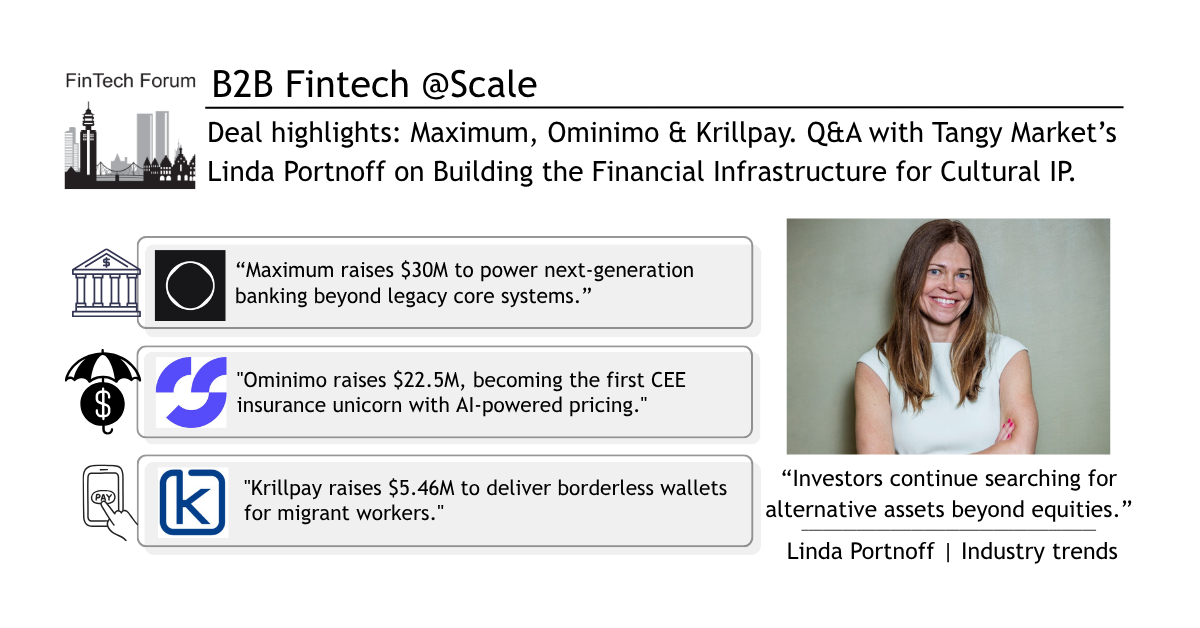
B2B FinTech @Scale Deal Highlights: Maximum, Ominimo & Krillpay.
Samarth Shekhar highlights startups that can help scale financial services by unlocking new customer segments or product offerings via B2B partnerships.
KrillPay can be a great partner to corporates employing large migrant workforces – think agriculture, logistics, construction, hospitality etc. Offerings like payroll and earned-wage access, giving workers a borderless wallet that holds, spends, and remits without a traditional bank relationship. This can help avoid e.g. the high remittance fees, turn payroll into a retention and welfare benefit that lowers churn in high-turnover labour forces, and enable further embedded financial products e.g. savings, micro-credit or insurance.
Ominimo — An insurer can use Ominimo‘s AI-driven pricing and data-segmentation engine to acquire motor customers at scale and improve loss ratios through sharper risk selection, as Signal Iduna and DA Direkt already do as carrier partners. This unlocks a high-growth distribution channel across new European markets without the insurer having to build the digital front end or pricing models, and the same segmentation capability can be extended into adjacent personal lines — turning a motor-insurance partnership into a broader platform for profitable, data-priced retail underwriting.
Maximum‘s AI-native operating system can help US banks replace their legacy cores – finally enabling them to launch e.g. real-time payments, embedded finance, stablecoin rails, or AI products. This can help them unlock new revenue lines and address digitally-native segments e.g. younger consumers, BaaS fintech partners, SMEs needing embedded credit etc.
Read on for more on the founders and investors in the news last week. If you are building or backing “what’s next in finance” and want to spread the word with our network of 20K+, reach out to Samarth Shekhar or Frank Schwab.
Mobile has become the primary gateway through which billions of people access information, commerce, and financial services
by Frank Schwab
By 2023, the number of unique mobile phone users exceeded 5.48 billion, representing 68% of the global population. In banking, mobile usage among U.S. adults rose from just 18% in 2010 to more than 80% by 2023. More than 10,000 U.S. bank branches closed between 2010 and 2023 as routine payments, transfers, account management, and service interactions moved into the app.
For customers, mobile banking now means instant onboarding, real-time access, peer-to-peer payments, low-friction commerce, and greater financial inclusion. For banks, mobile is no longer simply another channel — it is reshaping the operating model, customer relationship, and competitive landscape.
Read more: https://www.linkedin.com/feed/update/urn:li:activity:7488832069175840768/
VENTURE FINANCING
KrillPay — borderless digital wallet for migrant workers
KrillPay, a Birmingham, Alabama-based fintech, has raised $5.46 million in a seed round to build a borderless digital wallet designed to provide financial services for migrant workers and their families. The platform targets a large and structurally underserved customer segment: migrant and cross-border workers who send remittances home and who are frequently locked out of mainstream banking due to documentation, credit-history, or cross-border identity barriers. KrillPay’s wallet combines a spending account with low-cost international transfer capability, allowing workers to hold, spend, and send money across borders without a traditional bank relationship. The company positions itself as financial infrastructure for a population that moves money internationally at high frequency but pays disproportionately high fees to do so through incumbent remittance channels.
Source: PitchBook — KrillPay seed round, August 2026
Calingo — CHF 3.2 million to scale pet insurance
Calingo Insurance, a Zurich-based pet insurance provider, has closed a funding round with participation from Zürcher Kantonalbank, StartAngels, EquityPitcher and existing investors, and has since expanded its raise through a CONDA crowdinvesting campaign. Leveraging their experience from working in insurance companies, Calingo’s founders developed a digital B2B2C business model which integrates insurance products into the point-of-sale of sales partners — embedded at the point of need, directly at the breeder, via vets or pet shops — allowing end-customers to obtain personalised insurance. The Swiss pet insurance market is significantly underinsured: Switzerland has around 2.5 million dogs and cats, yet less than 10% are insured. Calingo operates as an MGA, handling product development, sales, service and claims, while risk-carrier partners manage risk and regulation. By the end of 2025 the company had built a portfolio of CHF 8.3 million in recurring premiums, with B2B2C distribution partners including Allianz Suisse, SWICA, Coop, Qualipet, Brack.ch and a network of more than 200 veterinary practices.
Source: https://www.conda.ch/en/calingo-crowdinvesting-digital-pet-insurance-on-conda-ch/
Ominimo Raises $22.5 Million at $1.6 Billion Valuation
Serbian-Hungarian insurtech Ominimo has secured a $22.5 million Series B investment led by the venture capital arm of the European Bank for Reconstruction and Development (EBRD), reaching a valuation of $1.6 billion and becoming the first insurance unicorn in Central and Eastern Europe. Established in 2024, Ominimo develops AI-powered digital motor insurance, combining data science, machine learning, and proprietary insurance technology to analyse driver and vehicle data for personalised pricing. The company is nearing one million customers across four European markets (Hungary, Poland, the Netherlands, Sweden) and has grown its annualised gross written premium run-rate 12x, from €26.3 million in 2024 to about €307 million. Ominimo currently operates as a managing general agent — managing pricing, distribution and claims while underwriting risk is provided by partner carriers including Signal Iduna and DA Direkt (Zurich’s German unit), with Zurich having taken a 5% stake in 2025. Part of the funding will be used to secure its own insurance licence and retain more underwriting economics, launch new business lines, and enter the US market in 2027.
Maximum lands $30m to rip out banks’ legacy cores
Maximum, an AI-native operating system builder for banks, has come out of stealth after securing a $30m Seed round, ranking among the biggest Seed raises the FinTech industry has seen.
CRV led the investment, joined by Pear VC, Restive, Plug and Play Ventures, Anthemis and other backers. The company was established by Randy Fernando, a serial FinTech founder whose previous ventures include Vault, acquired by Acorns in 2017, and Power, purchased by Marqeta in 2023.
The startup is targeting the ageing, disjointed technology stacks that underpin much of the banking sector. Among the almost 5,000 banks operating in the US, over 70% still run on core platforms engineered in the last century, well before the arrival of mobile banking, real-time payments, digital currencies or AI.
https://fintech.global/2026/08/04/maximum-lands-30m-to-rip-out-banks-legacy-cores/
As these stories prove, financial innovation is no longer about incremental updates—it is about reimagining complete ecosystems. Whether it is unlocking alternative investments through cultural IP, bringing real-time capabilities to legacy banks, or expanding global access through mobile tech, the future of finance is being actively built by leaders who dare to challenge old paradigms.
We hope today’s insights fuel your strategic vision and inspire new possibilities for your own journey. Until next week, keep innovating, stay driven, and thank you for being part of our global community.