
There’s a particular kind of momentum that builds when an industry stops asking “what’s possible” and starts asking “what’s next” — and this week’s edition sits right at that inflection point.
We open with a conversation that gets to the heart of it: Nils Feigenwinter of Bling on what it actually takes to make financial literacy part of family life, not just a feature bolted onto a banking app. It’s a story about starting young — literally, as a 20-year-old founder — and building patiently toward something that now touches over 350,000 families.
From there, Samarth Shekhar turns his lens on four companies quietly reshaping how financial services scale — not by chasing new customers, but by unlocking the ones institutions already have. And Frank Schwab looks back at a $5 million lesson from the early 2000s to ask a question every bank still needs to answer today: proving something can be built isn’t the same as proving it should be.
We close, as always, with the week’s funding highlights — a reminder that behind every headline number is a team betting on a better version of finance.
Settle in. This one’s worth the read.
A Q&A with Nils Feigenwinter from Bling on Building the Future of Family Finance

Nils Feigenwinter was still a teenager when he started asking a question most adults never think to ask: why does financial education look almost exactly the same as it did a generation ago, while everything else about growing up has gone digital? At just 20, he co-founded Bling with Leon Stephan to close that gap — starting with a simple prepaid card for kids and building it into a full-blown family finance platform.
Today, Bling counts over 350,000 active family members, has completed its first acquisition, and is now extending its reach into banks and schools through white-label and B2B offerings. We sat down with Nils to talk about building for three very different customer groups at once, why banks are warming up to fintech partnerships, and what it really takes to make financial literacy part of everyday family life — not just a lesson, but a habit.
1. Tell us about yourself / your co-founder(s).
I co-founded Bling together with my co-founder, Leon Stephan. From the very beginning, I kept asking myself one question: why do children and teenagers grow up in a fully digital world, while the way we teach them about money has barely changed in decades? At the same time, financial education still plays far too small a role in schools and everyday life.
That’s exactly what we set out to change.
Leon brings the technology perspective, while I focus primarily on product, strategy and partnerships. That combination has worked extremely well for us from day one.
What started as a prepaid card for children has gradually evolved into a platform for family finance. Our ambition was never to build just another banking app. We want to help families foster financial independence from an early age and we’re building the infrastructure to make that possible.
Read more from the interview: Bling on Empowering Families and Modernizing Youth Banking
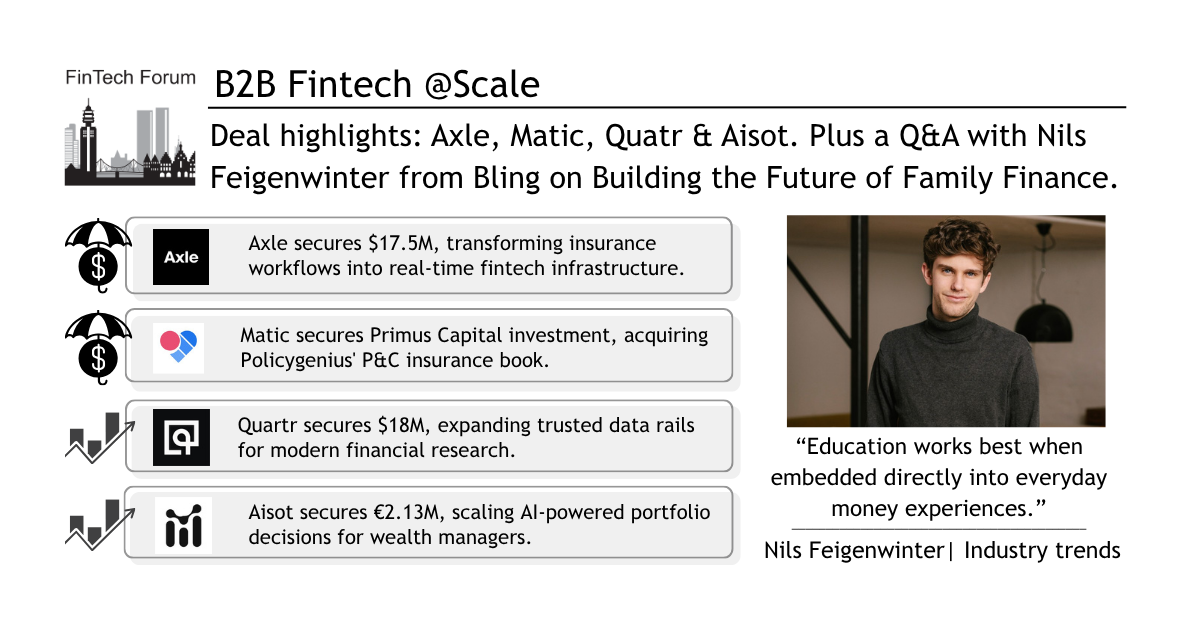
B2B FinTech @Scale Deal Highlights: Axle, Matic, Quatr & Aisot.
Samarth Shekhar highlights startups that can help scale financial services by unlocking new customer segments or product offerings via B2B partnerships.
Axle is enabling carriers to become a gateway to the businesses and consumers verifying coverage- auto dealers, lenders, mortgage servicers, employers etc. Every time a dealer or lender pings Axle to verify a policy, the carrier sees a real-time signal of a customer at a coverage-decision moment, which is exactly when cross-sell, win-back, or usage-based pricing becomes possible. Rather than sitting passively behind a broker, a carrier that plugs into Axle turns millions of verification events into a data and origination channel, and defends against disintermediation by owning the API rails that the “real economy” already runs on.
Matic‘s embedded insurance marketplace is purpose-built to sit inside the home- and auto-ownership journey that banks already own — mortgage origination and servicing, auto lending, retail banking. It offers a turnkey way to monetise a moment it already controls (a mortgage closing, an auto loan) by embedding home or auto insurance comparison from 70+ carriers, earning commission and deepening the customer relationship without becoming a licensed agency itself. The Policygenius P&C acquisition shows the model scaling — a bank can hand Matic an existing book or a raw customer flow and let it run the shopping, placement, and servicing. It converts a transactional lending relationship into a recurring, protection-anchored one.
Quartr is the first-party data backbone for company research — structured transcripts, filings, and IR events from 15,000+ companies, with every AI answer linked to source. SEB participating in the round is the signal: a bank can embed Quartr‘s API beneath its own research, wealth, and advisory products to give analysts and relationship managers instant, citable company intelligence without building the ingestion pipeline. A private bank or asset manager can offer AI-driven research and portfolio commentary to a much broader client base (down into the mass-affluent) at a fraction of the cost, because the underlying data layer is bought rather than built.
Aisot gives smaller investment firms access to professional quant, AI, and data infrastructure for portfolio construction without building it, and gives larger asset managers additional signals. For a bank’s wealth arm, it can enable personalisation at scale: agentic AI that runs the full portfolio lifecycle (strategy, backtesting, rebalancing, monitoring), and lets the institution offer tailored, actively-managed portfolios to more clients without adding portfolio managers. The transparency and explainability angle matters for a regulated buyer — it lets the bank deploy AI-driven investment decisions while keeping the audit trail supervisors require.
Read on for more on the founders and investors in the news last week. If you are building or backing “what’s next in finance” and want to spread the word with our network of 20K+, reach out to Samarth Shekhar or Frank Schwab.
In 2000, Deutsche Bank built mobile banking based on WAP technology for the Nokia 7110.
by Frank Schwab
We spent about $5 million to launch it at CeBIT—then the largest technology fair in the world. All the functions we now associate with modern mobile banking were already available, yet the target market at the time was no more than 10,000 potential customers. We just never looked at that.
The experience captures the decision tension at the centre of this review: a team can prove that something can be built without proving that it should be built—or that the organisation is ready to scale it.
Read more: https://www.linkedin.com/feed/update/urn:li:activity:7494996465069678593/
VENTURE FINANCING
ETH Zurich spin-off Aisot Technologies bags €2.13 million to bring agentic AI to portfolio management
Aisot Technologies (Aisot), a Zurich-based startup offering AI-driven portfolio intelligence for institutional investors, has closed a €2.13 million (CHF 2 million) Seed extension round. The round was backed by existing and new investors, including family offices and experienced angel investors. Also joining as a new investor is Felix Haldner, former Partner at Partners Group and former President of the Swiss Funds & Asset Management Association (SFAMA). Founded in 2021 as an official ETH Zurich spin-off, Aisot offers AI-driven solutions for portfolio optimisation and risk management to asset and wealth managers and family offices. The company combines quantitative financial analysis, machine learning and LLM-based news sentiment analysis into institutionally deployable forecasting and decision-making models. The platform helps large asset managers identify additional signals and gives smaller investment firms access to professional data, AI and quant infrastructure for portfolio construction and personalisation, without having to build and operate it themselves. Its agentic AI delivers data-driven decision support across the full portfolio management lifecycle, from strategy and backtesting to rebalancing, optimisation, and monitoring. CEO Stefan Klauser: “We want to help wealth managers in Switzerland and internationally to integrate AI into their investment processes in a way that is well-founded, transparent and impactful.”
Axle Raises $17.5M Series A to Connect Insurance Carriers to the Real Economy
NEW YORK, Aug. 11, 2026 /PRNewswire/ — Axle, the AI-native clearinghouse for insurance, today announced $17.5M in Series A funding led by Base10 Partners. The round included continued investment from Y Combinator and Gradient, with participation from Stage 2 Capital and industry angels, including the founders of Cover Genius. They join existing investors, including the early team at Plaid. In the last six months, Axle has tripled the workflows it automates and now clears more than $100B in coverage annually for over 4,000 auto dealers, rental car companies, mortgage lenders, auto lenders, and employers — a roster that includes dozens of Fortune 500 customers such as Rocket Mortgage, Avis, Experian, and Sonic Automotive. Axle has sped up these workflows by 20x while recovering hundreds of millions in losses for its customers. Founded in 2022 by Cameron Duncan, Armaan Sikand, and Nihar Parikh, Axle integrates fragmented carrier systems into a single, clean API that allows software and AI agents to automate verification and policy management workflows. Having proven the model in five distinct markets, Axle will use the capital to expand its clearinghouse to more than 50 segments spanning Home, Auto, Renters, Commercial, and Specialty insurance, while deepening direct relationships with carriers who increasingly use Axle as a governed gateway to the businesses and consumers they serve. Base10’s Adeyemi Ajao: “In 2026, no one should be faxing PDFs or sitting on hold to confirm a policy. The Axle team built the rails that make insurance programmable.”
Quartr Raises $18M to Extend Its Global Leadership in First-Party IR Data
NEW YORK & STOCKHOLM — Quartr, the world’s leading first-party data layer for institutional finance and AI, today announced it has closed a $18 million funding round, led by existing investor Altos Ventures with participation from new investor SEB (publ.). With this investment, Altos is now Quartr’s largest shareholder, a clear signal of confidence in the company’s products and long-term outlook. Quartr continues to grow at triple-digit rates with strong unit economics, including Net Revenue Retention around 120%. Its customer base includes some of the largest hedge funds, asset managers, and technology companies in the world. Quartr is the AI infrastructure for company research, leading globally in coverage of live public company events. Structured, real-time IR data is delivered through two offerings: Quartr Pro, an AI research platform used by hedge funds, asset managers, equity researchers, and IR professionals, with every AI-generated answer linked back to its source document; and Quartr API, the data backbone for builders, feeding structured audio, live transcripts, filings and slide decks from more than 15,000 companies across over 65 markets into other platforms and AI systems. More than 800 of the world’s most demanding financial institutions and technology companies research and build on Quartr. The company will use the funding to accelerate product development and widen its coverage of public company data worldwide.
Matic Secures Minority Investment From Primus Capital and Acquires Policygenius’ Property and Casualty Insurance Book
Columbus, Ohio, June 24, 2026 (GLOBE NEWSWIRE) — Matic, a leading embedded insurance platform, today announced a strategic growth investment from Primus Capital alongside the acquisition of Policygenius’ property and casualty insurance portfolio, marking continued momentum in the company’s expansion. The investment will help support Matic’s continued development of its proprietary insurance platform, expansion of embedded partnerships, and pursuit of inorganic growth opportunities. “We have created a highly scalable platform that enables us to efficiently integrate this and future books of business while ensuring a great experience for these customers.” With these two major developments, Matic is poised to further advance its mission to simplify the world of insurance for consumers, insurance carriers, and financial institutions. Since 2014, Matic has changed the landscape of the insurtech industry by integrating insurance within the home and auto ownership experience. Today, Matic’s digital marketplace has over 70 insurance carriers, as well as over 100 distribution partners in industries ranging from mortgage origination and servicing to banking, real estate, personal finance, and more. With a single-minded focus on advocating for policyholders, Matic has created an easy and transparent shopping process, saving customers hours of work and over $900 on average each year.
Source: https://matic.com/blog/matic-policygenius-acquisition-primus-investment/
Behind every funding round, product launch, and strategic partnership lies something more meaningful: founders choosing to solve problems that matter and institutions willing to back meaningful change.
Thank you for being part of the FinTech Forum community. Whether you’re building, investing, or shaping the future of financial services, we hope these stories offer fresh perspectives and valuable connections. Until next week, keep questioning convention, keep supporting innovation, and keep building what’s next in finance.