
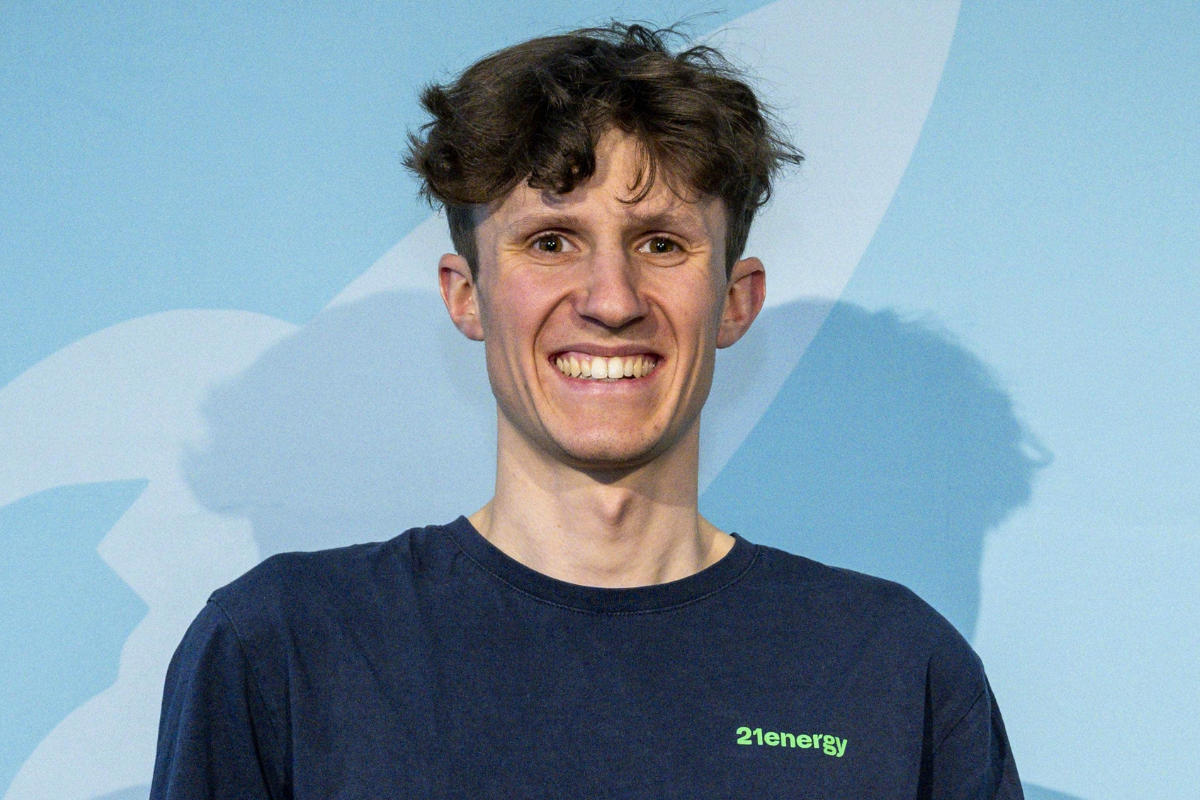
What do the Karakoram mountains and a Bitcoin space heater have in common? More than you’d think — at least if you ask Lukas Waldner.
At just 25, the Innsbruck native has already led a first ascent on a 6,653-metre peak in Pakistan, managed the largest German-speaking Bitcoin conference, and co-founded a company that is quietly rewriting the economics of home heating across Europe. Together with CEO Maximilian Obwexer, Lukas built 21energy from a bold idea born in 2022 — that the waste heat of a Bitcoin mining chip shouldn’t go to waste at all. The result is the Ofen, a certified space heater that warms your home and earns Bitcoin at the same time.
In just three years, 21energy has fulfilled over 10,000 orders, shipped to 36 countries, and hit €2.5 million in revenue — all while preparing to scale into industrial heating and grid-flexibility services. The company sits at a fascinating intersection: energy infrastructure, Bitcoin treasury, and the hard-nosed business of keeping people warm in winter.
We sat down with Lukas to understand how 21energy is positioning itself at the crossroads of the energy transition and the Bitcoin economy — and why this might be exactly the kind of infrastructure bet that financial institutions should be paying attention to.
1. Tell us about yourself / your co-founder(s).
I’m Lukas Waldner, Co-Founder and COO of 21energy. We build energy-infrastructure services powered by Bitcoin mining: repurposing ASIC waste heat into high-efficiency Bitcoin space heaters, and deploying mobile mining containers that provide demand-response capacity while converting surplus electricity into revenue.
Outside the company I’m an professional alpinist and athlete of the international Millet team, focused on fast-and-light alpinism on technical routes in the Alps, Karakoram and Himalaya.
2. Who are your target customers, and what problem / opportunity do you address for them?
We serve three customer groups. Private households and small businesses in the DACH region who want to heat with electricity, monetize part of the cost through Bitcoin mining, and reduce dependency on gas or oil. Industrial and commercial operators who need scalable heat sources and want to run a productive load rather than a pure consumption load. Energy companies and grid operators who need fast, flexible demand-response capacity to balance renewable generation.
The underlying problem is the same in all three cases: electric heat is clean but expensive, and the grid increasingly needs flexible loads that can switch on when there is surplus renewable power. We turn the heating load into a productive asset that earns revenue, stabilizes the grid, and replaces fossil heat.
3. What is your product / solution? Who do you compete with, and what is your USP?
Our core products are the Ofen 2 and Ofen 2 Pro, Bitcoin space heaters that convert nearly 100% of electrical input into useful heat while running an ASIC miner inside. We also resell Bitmain, MicroBT and Canaan hardware, and we are scaling into central heating integrations and mobile mining containers for industrial sites.
Direct competition is fragmented. A handful of small players sell mining heaters in Europe, traditional heating brands sell electric heaters without the revenue layer, and industrial mining operators sell hashrate without the heat use case. Nobody combines a certified consumer product, an industrial offering and an emerging grid-service layer under one roof.
Our USP is operational maturity in a category most players are still prototyping in. Over 10,000 orders fulfilled, 2.5 million euro revenue in 2025, distribution into 36 countries, and more than 1,000 customer reviews averaging 4.8 out of 5. We control the full stack from hardware sourcing and firmware to fulfillment, after-sales and the financial layer.
4. How do you help scale financial services, and how can financial institutions partner with you?
Two angles are relevant for FIs.
First, Bitcoin-denominated yield products. Our deployed fleet produces a continuous stream of Bitcoin. We are building rental and service structures around that fleet where customers participate in the cash flow rather than buying hardware outright. For financial institutions this opens a new asset class: contract-backed, hardware-collateralized cash flows with a Bitcoin yield component, suitable for treasury allocation, structured products, or hybrid fund vehicles.
Second, financing rails for energy infrastructure. Scaling our rental fleet and central-heating integrations is capital-intensive, but the underlying contracts and hardware are bankable. Banks, leasing companies and infrastructure funds can partner with us as financing providers behind a productized customer offering, with the asset, the cash flow and the operational responsibility sitting on our side.
A concrete example: a partner bank or leasing provider funds the hardware behind a rental contract, the end customer pays a monthly fee, we operate the asset and split the upside. The bank gets a secured, yield-bearing exposure, the customer gets clean heat without capex, and we scale without burning our own balance sheet.
5. What relevant industry trends or market shifts should we be watching?
Three shifts matter. Heat decarbonization in Europe is accelerating under regulatory pressure, and electric heat is the default replacement for gas, but it needs a revenue layer to be affordable at scale. Grid flexibility is becoming the bottleneck of the energy transition, and Bitcoin mining is the only load that can ramp in seconds across megawatt scale without capex from the grid operator. And Bitcoin itself is moving from a retail-speculation narrative into a treasury and infrastructure-financing narrative, which changes how banks, corporates and family offices look at exposure.
For resources, the Digital Energy Council, the Bitcoin Policy Institute on grid integration, and ERCOT’s published data on demand response in Texas are the most useful starting points.
6. What is your current stage and traction, and how can our network help?
We closed a seed round in September 2024 and are structuring our Series A now. 2025 revenue was 2.5 million euro, with more than 10,000 orders fulfilled and a production capacity of 50,000 units annually. We sell into 36 countries, with DACH as the primary market.
The network can help in two ways. Introductions to banks, leasing providers and infrastructure funds interested in financing hardware-backed rental fleets and grid-service assets. And introductions to family offices and strategic investors with a thesis on energy infrastructure, Bitcoin treasury or both, as we build out our Series A round.
7. What’s on your bookshelf or podcast app? Your favourite place for a coffee or a drink?
Honestly, I almost never read books, my input diet is podcasts, mostly anything around Bitcoin, energy and macro. Favorite spot is less a place than a moment: anywhere outside in Innsbruck when the sun hits the mountains in the early morning or late evening.
21energy’s story is still early — and that’s precisely what makes it compelling. Lukas and Maximilian are building at a junction most investors are only beginning to notice: where the energy grid’s need for flexibility meets Bitcoin’s need for productive infrastructure, and where the humble act of heating a room becomes a revenue-generating asset.
As Europe accelerates its shift away from fossil fuels and grid operators scramble for demand-response solutions, the companies that have already found the product-market fit — the certified hardware, the customer trust, the operational stack — will be the ones to watch. 21energy has all three.
The Series A is being structured. The category is forming. The question is who moves first.