
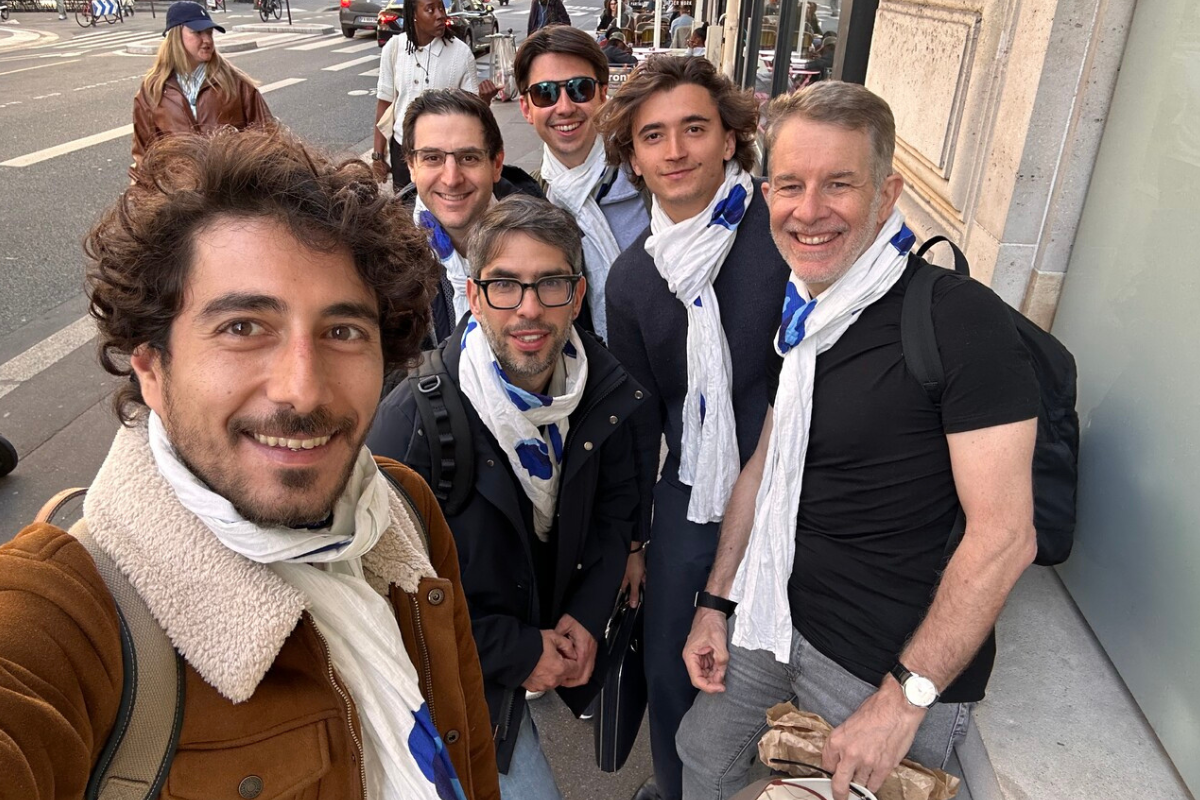
After leading his first venture from regulatory approval to multimillion-euro fundraising, an unexpected co-founder dispute brought that chapter to an abrupt end. Rather than stepping away from innovation, André Dibé returned with a more ambitious vision: Talwex, a regulated blockchain infrastructure designed to modernize one of finance’s oldest and least digitized markets—the global bond market. Alongside trusted collaborators Pierre Voillet and Iloan Valero, he is rethinking how bonds are issued, traded, settled, and managed for the next generation of institutional finance.
In this conversation, André shares the lessons behind his entrepreneurial journey, why tokenized bonds are reaching a pivotal moment, and how Talwex aims to provide the infrastructure—not the competition—that enables financial institutions to move faster, operate more efficiently, and unlock new sources of liquidity.
1 — Tell us about yourself / your co-founder(s).
I’m André Dibé, a Canadian-Lebanese entrepreneur building my second venture. I was born and raised in Beirut and left Lebanon for France in 2012 to pursue my studies. I graduated from two of France’s top engineering schools and a jazz conservatory, and in 2022 I built my first startup, Kamea Labs, developing next-generation, blockchain-based crowdfunding tools. I secured AMF regulatory approval in France in 2023, raised around €2M in 2024, and signed €500K in contracts within our first six months of operation. We were at the top of our game when, in April 2025, a co-founder dispute forced me out of the company I had built.
A year after he took over, he drove it into bankruptcy, while my investors backed me to keep innovating. So in 2026 I founded Talwex, the first end-to-end, blockchain-based infrastructure for bonds. I chose to build it as sole founder but surrounded myself with people I trust and had already worked with: Pierre Voillet, a serial entrepreneur turned blockchain advisor, and Iloan Valero, my right hand since my first venture, granting them equity from the start and treating them as co-founders.
2 — Who are your target customers, and what problem / opportunity do you address for them?
Financial institutions still trade bonds as if it were 1984: phone calls, faxes, manual entry, and tangled back-and-forth between desks and counterparties make everything slow and tedious. Talwex provides the regulated, blockchain-based rails that let these institutions issue, trade, and manage bonds end-to-end, with the legal, regulatory, and administrative workflow fully automated. We don’t replace the market’s participants: we equip the existing ones to finally bring bonds into the 21st century.
3 — What is your product / solution? Who do you compete with, and what is your USP?
Talwex develops an end-to-end, blockchain-based infrastructure for bonds. The marketplace lets users issue, trade, and manage bonds, with venue-native tooling for licensed market makers to provide liquidity and for dealers to structure options and derivatives on bonds. Regulatory workflows (registry updates, reporting…) are automated. The infrastructure is designed for financial institutions such as banks, funds, and family offices, and connects easily to legacy systems via an API and a FIX server, while AI agents can read and write market data through an MCP server.
Our USP is twofold: we cover the whole lifecycle on a single set of regulated rails, and we never compete with our own users. Talwex doesn’t trade, make markets, or hold assets itself, we build the regulated infrastructure that lets the market’s existing participants (issuers, dealers, market makers, custodians) do what they already do, faster and on-chain.
4 — How do you help scale financial services, and how can financial institutions partner with you?
The bond market is still largely OTC. Traders route through venues like MarketAxess or Tradeweb, and a trade can take days to settle while it mobilizes trading, compliance, and finance teams, with settlement reconciled manually between custodians. Talwex compresses this to seconds through instant settlement, automated compliance, and a single regulated venue where licensed market makers can provide continuous liquidity. Today we’re testing a first component of the infrastructure: a bond facility where holders can pledge illiquid bonds to draw instant liquidity without selling them, while liquidity providers earn yield backed by coupon-paying collateral. For an institution, that facility is the natural way to partner with us: a holder of illiquid or hold-to-maturity positions can plug in, unlock liquidity against those bonds, and help shape the product against real balance-sheet needs.
5 — What relevant industry trends or market shifts should we be watching? Any research or resources you can point us to?
Three shifts validate our timing. First, regulatory clarity: the SEC’s January 2026 Joint Statement on Tokenized Securities confirmed that tokenized securities are securities and map onto existing broker-dealer/ATS frameworks, and Chair Atkins’s Project Crypto signals a path toward unified, compliant venues for tokenized-securities trading, lending, and settlement — our exact model (SEC Statement on Tokenized Securities, Jan 28, 2026; Atkins, Inside Project Crypto, Nov 12, 2025).
Second, collateral mobility is now consensus, with borrow-USDC-against-tokenized-bonds live in production — the mechanic behind our instant liquidity (DTCC Collateral AppChain; Apollo ACRED on Morpho; Broadridge DLR; JPMorgan Kinexys repo).
Third, the institutional cohort we need has converged on Canton, the chain we’re building on, freshly capitalized at $355M by a16z, Apollo, HSBC, and Citadel Securities (Digital Asset, Jun 11, 2026; Messari, Understanding Canton Network; DTCC–Canton US Treasury tokenization, H2 2026).
6 — What is your current stage and traction, and how can our network help?
We have a live MVP: a bulletin-board marketplace for blockchain-based issuance, digitization, and trading of corporate bonds, with three early clients and two serious leads in the pipeline. We’re now building our bond facility, which lets institutions borrow against illiquid bonds: it targets holders of hold-to-maturity or otherwise illiquid positions who need to unlock liquidity instantly without selling. This is where the network can help, as we’re looking for professionals matching that profile to stress-test the model, give us critical feedback, and help us iterate toward something the industry can use at scale.
7 — What’s on your bookshelf or podcast app? Your favourite place for a coffee or a drink?
Psychology and neuroscience books, the Paul McCartney biography, and today’s copy of L’Orient-Le Jour. My favorite spot for a coffee or a drink is the Grand Meshmosh Hotel on the Saint Nicolas Stairs in Beirut.
As traditional financial ecosystems reach a tipping point, Talwex stands out not by trying to replace the market’s current heavyweights, but by handing them the modern, automated weaponry they need to scale. André Dibé’s resilience and clear-eyed vision for a unified, blockchain-backed bond rail show that the tokenization wave is no longer a distant trend—it is actively reshaping institutional liquidity today.
With a live MVP already in play and an innovative bond facility on the horizon, Talwex is a startup to watch closely as they bridge the gap between legacy finance and digital efficiency. Stay tuned to our next editions as we continue to track how pioneers like Talwex are redefining the boundaries of global capital markets.