
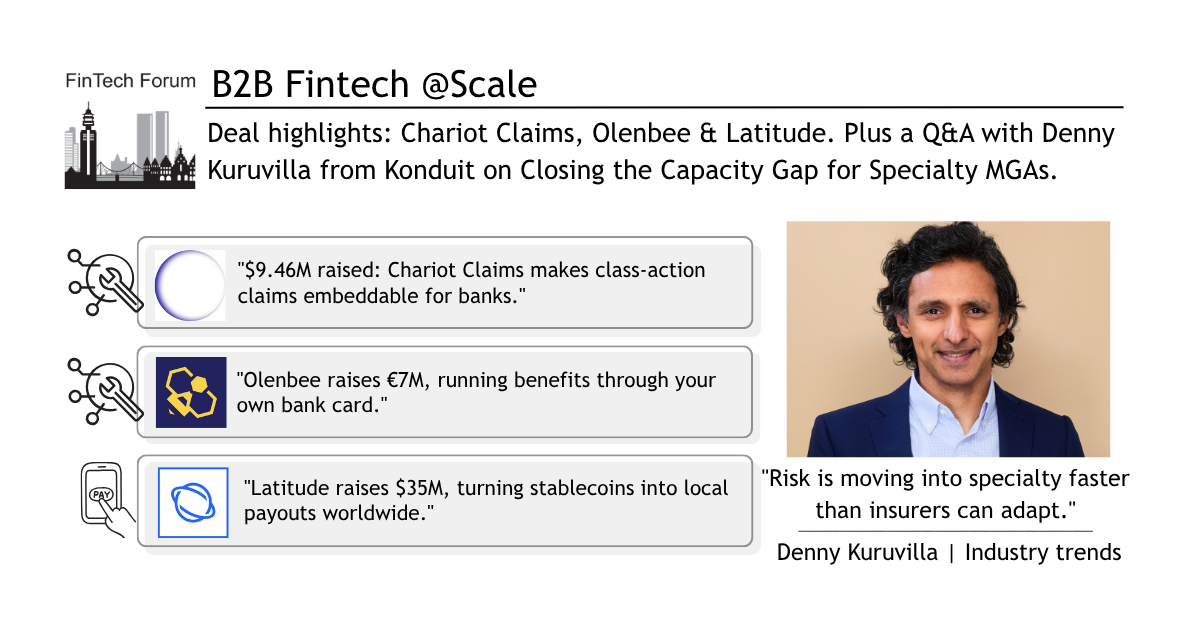
This week’s edition moves from insurance infrastructure to open banking to a public-sector cautionary tale — proof that the future of finance is being built, and occasionally rebuilt, on every front at once.
Our Q&A of the week sits down with Denny Kuruvilla of Konduit, who’s compressing a year-long capacity hunt for specialty MGAs into a matter of days. Samarth Shekhar turns his eye to three startups quietly unlocking new B2B partnerships — Chariot Claims, Olenbee, and Latitude — each finding a way to embed a service banks have historically struggled to offer well.
Frank Schwab brings a sobering counterpoint: a £3 billion lesson from NS&I on what happens when transformation outpaces discipline. And as ever, we close with the week’s funding highlights — the ventures raising the capital that will shape what comes next.
Settle in; there’s a lot worth your attention this week.
A Q&A with Denny Kuruvilla from Konduit on Closing the Capacity Gap for Specialty MGAs

Managing general agents are quietly becoming one of the fastest-growing corners of US insurance — yet getting the capacity to back a program can still take the better part of a year. Denny Kuruvilla has watched that friction from every seat at the table: three ventures built, fifteen years spent inside insurance technology at TD Insurance and Hub International, and a stack of patents in AI and big data along the way. His latest venture, Konduit — backed by Aviva and incubated by Founders Factory — sets out to compress that months-long capacity hunt into a matter of days, structuring an MGA’s program and surfacing the gaps before any capacity provider sees them, all in twenty minutes flat. Four months after going live with zero marketing spend, Konduit already counts a dozen MGAs across three continents and a closed institutional cheque behind its seed round. We sat down with Denny to hear how he’s building the rails for a market that badly needs them.
1. Tell us about yourself.
I’m a three-time founder with fifteen years building insurance technology products and platforms with extensive experience in the US and Canada markets — TD Insurance, Hub International among them. Two prior insurance startups as Co-Founder, and several patents in AI and big data.
Read more from the interview: Konduit on Closing the Capacity Gap in Specialty Insurance
B2B FinTech @Scale Deal Highlights: Chariot Claims, Olenbee & Latitude.
Samarth Shekhar highlights startups that can help scale financial services by unlocking new customer segments or product offerings via B2B partnerships.
Chariot Claims: US class-action settlements distribute on the order of tens of billions of dollars annually, but most consumers never claim it because discovery and filing are too complex. Chariot makes this easier- e.g. a bank can embed Chariot to surface eligible class action and settlement claims to customers based on their transaction history- at zero cost to them and no balance sheet risk to the bank. For an insurer, the same discovery engine can be relevant to subrogation and premium recovery workflows.
Olenbee: The French meal voucher market alone is at a. €8-9bn, covering ~5mn employees, while the broader European employee-benefits/perks market is well into the tens of billions of euros- historically locked up by closed schemes like Edenred, Swile, and Pluxee. Olenbee runs benefits (meal vouchers, gift cards, soon cashback and mobility) directly on the employee’s existing personal bank card via open banking. A bank can offer its business customers a fully embedded benefits programme without issuing a separate instrument or joining a restricted merchant network.
Latitude: Global cross-border payments exceed $190tn annually, of which the B2B and SMB segments that Latitude targets represent tens of trillions. Latitude settles in stablecoins but delivers funds through the local methods recipients already use, e.g. Pix in Brazil, UPI in India, mobile money in Kenya. This can help a bank, payroll platform, or remittance provider serve migrant worker and emerging market corridors competitively. For a bank, plugging into Latitude means it can offer corporate clients- e.g. marketplaces, payroll and EOR platforms, remittance businesses- fast, cheap, local-currency disbursement to contractors and employees across 50+ countries, a product its own correspondent banking rails deliver slowly and expensively.
Read on for more on the founders and investors in the news last week. If you are building or backing “what’s next in finance” and want to spread the word with our network of 20K+, reach out to Samarth Shekhar or Frank Schwab.
£3 Billion. Five contracts. £111 million spent — and no modernised service live.
by Frank Schwab
NS&I’s transformation should be compulsory reading for every bank board planning to break up a long-term outsourcing model.
After roughly 25 years with a largely single-supplier operating model NS&I set out to disaggregate the estate across multiple providers and modernise the underlying technology.
The economics deteriorated dramatically: estimated transformation and associated operating costs through 2030–31 rose from £1.7bn to £3.0bn — £1.3bn above the 2020 baseline.
By March 2024 £111m had already been spent without any modernised live service while more than £43m went to consultants and legal support.
Read more: https://www.linkedin.com/feed/update/urn:li:activity:7504025979560865792/
VENTURE FINANCING
Chariot Claims raises $9.46M (SEC filing)
Chariot Claims, a legal technology platform that helps everyday people file claims and secure compensation from corporations that violated their rights, has raised $9.46M according to a recent SEC filing. The filing indicates that the total offering is for $10M and there were eleven investors in this close. Chariot Claims was founded by Jonathan Chen and Zim Hang in 2022 and has raised $15.2M in total funding. The Brooklyn-based platform connects consumers with a network of more than 20 partner law firms to identify and manage mass-action and class-action lawsuits, automating the process from claim discovery and paperwork through connecting users with counsel and tracking payouts. The contingency-based model has processed more than 65,000 claims expected to yield $92 million in gross settlements; with the new capital, the company plans to expand into new claim categories such as wage theft, housing fraud, and data breaches.
Source: https://www.alleywatch.com/2026/09/the-alleywatch-startup-daily-funding-report-9-3-2026/
Olenbee raises €7m to scale real-time perks tech
Olenbee raises €7m to scale its AI-powered real-time employee benefits platform. The round was backed by GO CAPITAL, with contributions also coming from Bpifrance and the European Regional Development Fund (ERDF). A group of established entrepreneurs and business angels from the tech ecosystem, including Val de France Angels and All’n Breizh, also joined the round. The fresh capital will allow Olenbee to step up its development across France, grow its client and user base towards a target of 80,000 users by early 2027, and extend its technology into new everyday use cases. Founded in 2024, Olenbee offers a variety of FinTech solutions that connects employee benefits with everyday card spending within companies. Using the app, employees can streamline expenses and more. [Model note: rather than issuing a dedicated meal-voucher instrument, the employee pays with their personal bank card and Olenbee’s open-banking layer, via partner Linxo, identifies the eligible expense after the transaction and reimburses it — inverting the classic closed-loop voucher model.]
Source: https://fintech.global/2026/09/08/olenbee-raises-e7m-to-scale-real-time-perks-tech/
Hedi — AI agent for insurance fraud investigation (Paris; early-stage watch)
Hedi is the AI agent for insurance fraud investigation — detecting and investigating manipulated images, AI-generated evidence, falsified documents, and suspicious claims, while clearing honest claims faster. The Paris-based insurtech targets one of the fastest-growing problems in claims: deepfake- and generative-AI-produced fake documents and images. Where legacy fraud tools focus on statistical anomaly detection (flagging outlier behaviour for human review), Hedi’s agent investigates the evidentiary content of a claim itself — the images and documents — placing it in the emerging “investigation AI” layer that sits downstream of detection and addresses the SIU capacity gap, where a large share of flagged claims never receive full investigation. [Included as an early-stage unique-idea watch; PitchBook logs a round but no public funding announcement was located at time of writing — amount and investors unconfirmed. Text above is the company’s own product description, not a funding announcement.]
Source: https://www.askhedi.com/solutions/property-casualty
Intermezzo Raises $10M to Build the World’s First AI-Native Global Payroll Platform
Intermezzo, a global payroll infrastructure company, today announced $10M in funding from Crosslink Capital, UKG Ventures, CloudPay, Character Capital, Behind Genius Ventures, and leading angel investors. The platform automates the highly complex and regulated world of international payroll. Intermezzo’s founding team spent a collective 40 years leading technical and product teams at Intuit, helping turn it into the fintech powerhouse it is today. Co-founder and CEO Siddharth Ram formerly served as Chief Architect at Intuit, where he built SMB infrastructure, and later served as CTO at Inflection and Velocity Global. Co-founder and CTO Kumar Ramanathan is the former Chief Data Architect at Intuit and CTO/Chief Architect of Velocity Global. The platform utilizes a proprietary architecture, deploying AI agents to automatically extract knowledge and convert source data into structured, machine-readable rules. This strategy shrinks the typical 20-day payroll processing cycle down to 24 hours and improves accuracy to more than 99%, while reducing cost. “Intermezzo acts as a white-label platform API provider for HCM and payroll companies, abstracting away the need to replicate country-specific bureaucratic requirements,” the company said. Its target customers are HCM platforms, employer-of-record (EOR) firms, and payroll bureaus that often have no localized payroll capabilities in most international markets, requiring them to work with multiple regional payroll vendors.
Latitude, founded by Stripe and Uber alums, raises $35 million to turn stablecoins into local payments
Stablecoins have made it exceptionally easy to move money across borders instantaneously. The problem that remains for users, especially those in emerging markets, is getting those funds to their preferred local payment methods. Texas-based global payments infrastructure company Latitude aims to change this by giving businesses the infrastructure to use stablecoins to send local currency through familiar methods, such as bank accounts and mobile wallets. Cofounded by industry veterans Cyril Mathew, Brian Wrightson, and Vivek Morzaria — their collective resumés include stops at well-known names like Stripe, Uber, Coinbase and Meta — Latitude announced Wednesday that it raised $35 million in a Series A round. Oak HC/FT, a venture and growth equity firm, led the round, with participation from NEA, Coinbase Ventures, Lightspeed Faction, and OpenFX. The Series A follows Latitude’s $8 million seed round and brings total funding to $43 million. Its technology connects stablecoin settlement directly with local payment methods — examples include Pix in Brazil, UPI in India and mobile money in Kenya — so recipients such as contractors, sellers, and employees can receive local currency within minutes rather than waiting days, without needing a cryptocurrency wallet. Latitude plans to use the funding to hire in compliance, engineering, legal, and sales, maintain its licenses across 45 U.S. markets, and pursue direct licensing globally.
Exclusive: Split Pay raises $125 million for rent and mortgage lending
Split Pay, a lending startup initially focused on renters, tells Axios that it’s raised $125 million in Series A and Series B funding. Khosla Ventures led both rounds, joined by Thrive Capital and Max Levchin. Why it matters: It’s an effort to make the consumer economy work more like the invoice-based business economy — which recognizes that income can be lumpy — by reconciling the timing discrepancy between large bills (once per month) and paychecks (twice per month). It’s also a BNPL-style bet that AI can be used to expand underwriting without also expanding losses. How it works: Split Pay lets renters or mortgage holders pay their entire bill on the due date, but floats up to 50% for up to 30 days. It charges 2% of the entire bill, plus a $10 monthly “subscription” fee, but doesn’t charge late fees or interest. If someone ultimately doesn’t pay, they no longer can use the service. Deal breakdown: Split Pay initially raised $15 million in seed funding in 2023, before scoring $25 million for its Series A round last fall and then around $100 million for the Series B. “We believe that AI is going to blow up underwriting, so we spent our first two years like a lab building a new foundation model focused on people under 40,” says co-founder and CEO Andrew Borovsky, a former Block/Cash App executive. “What we found was that our average consumer had $90,000 of income and generated around $2,100 in cashflow, but was still struggling and living paycheck-to-paycheck.”
Source: https://www.axios.com/2026/09/08/split-pay-khosla-125-million
Savvy Wealth Raises $100M Series C Led by Ryan Smith and Ryan Sweeney’s Halo Fund
NEW YORK, September 09, 2026 (BUSINESS WIRE) — Savvy Wealth (“Savvy”), an AI-native registered investment advisor (RIA) for independent financial advisors, today announced the successful close of its $100 million Series C funding round led by Halo Fund, the growth-stage venture firm co-founded by Qualtrics founder and Utah Jazz owner Ryan Smith and longtime Accel general partner Ryan Sweeney. Savvy is approaching $100 million in annual recurring revenue and is Inc. Magazine’s fastest-growing financial services company, supporting more than 150 independent advisors overseeing $9 billion in client assets. The oversubscribed round drew participation from existing investors including Thrive Capital, Industry Ventures, Canvas Prime, Index Ventures, House Fund, Euclidean Capital, Alumni Ventures, and Vestigo Ventures, and values the company at $600 million, bringing total funding above $200 million. Advisors who partner with Savvy get one modern, integrated platform rather than a stack of vendors. Savvy Intelligence, the AI-powered operating environment at the center of the platform, runs AI agents for each advisor on a unified data layer spanning CRM, investment management, compliance documentation, and client communications. The AI is not intended to interact with retail clients of Savvy Advisors, nor does the AI provide client-facing investment advice or investment decisions; advisors remain solely responsible for all advice and recommendations provided to their clients.
Every edition of B2B FinTech @Scale is really the same story told from different angles: infrastructure quietly being rebuilt, trust quietly being re-earned, and capital finding its way to the builders willing to do the unglamorous work first.
Whether it’s an MGA waiting months for capacity, a bank looking for its next embedded product, or a legacy institution learning the cost of moving too slowly — the throughline is the same. The future of finance won’t be announced; it’ll be assembled, deal by deal, decision by decision. Thank you for reading, and for building alongside us — see you next week.