
In a sector defined by relentless reinvention, the most compelling stories are those that quietly rewire the infrastructure of finance itself.
This week we bring you three such moments. Samarth Shekhar examines the B2B fintechs turning prediction markets, corporate treasury, and self-insurance into institutional-grade opportunities. Frank Schwab looks ahead to a world where machines no longer merely work for us—they begin to transact with one another. Our Q&A features André Dibé of Talwex, who is bringing one of finance’s oldest markets onto regulated blockchain rails. And we close with a curated look at the founders and rounds that continue to fuel the next chapter of financial innovation.
These are not incremental updates. They are signals of where capital, technology, and institutional demand are converging. We invite you to read on.
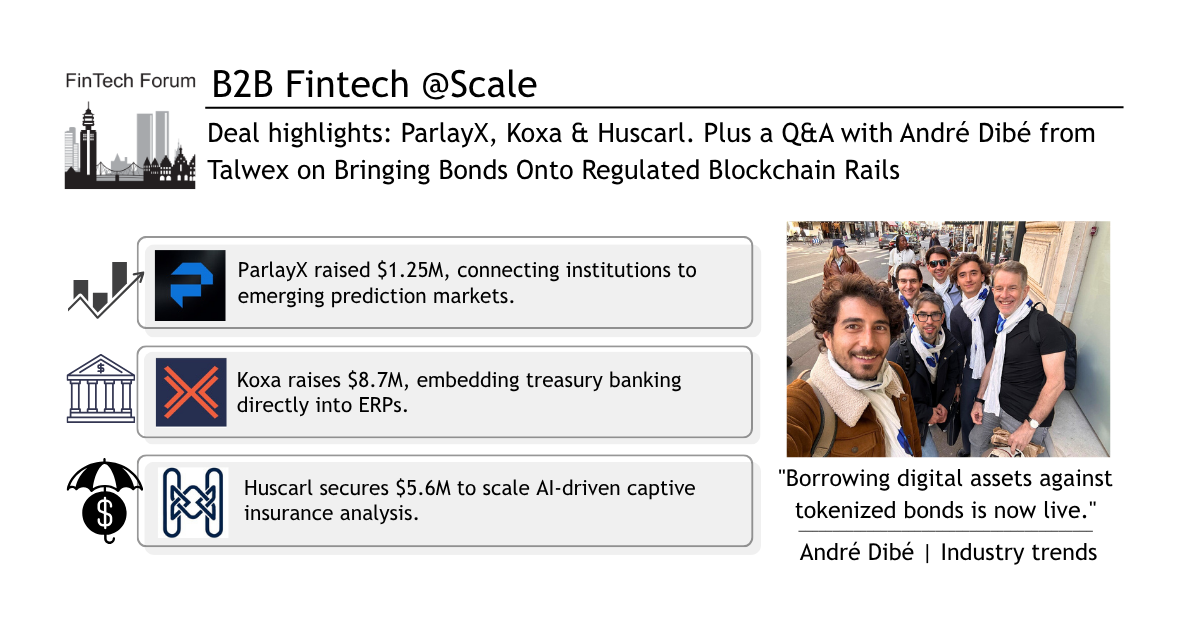
A Q&A with André Dibé from Talwex on Bringing Bonds Onto Regulated Blockchain Rails

B2B FinTech @Scale Deal Highlights: ParlayX, Koxa & Huscarl.
Samarth Shekhar highlights startups that can help scale financial services by unlocking new customer segments or product offerings via B2B partnerships.
ParlayX: Prediction markets have matured into a real asset class, but institutions still access them through retail interfaces with no custody, capital-control, or reporting layer. ParlayX provides the missing institutional plumbing- a single OEMS routing across Kalshi, Polymarket, and other CFTC-regulated venues. Though this is still early with regulatory clarity work in progress, this can be a new tradable asset class for a bank trading desk, using familiar infrastructure and without building venue-by-venue connectivity.
Koxa: A bank’s corporate customers operate on their ERP but use a separate portal for banking, forcing manual re-keying and reconciliation. Koxa extends the bank’s treasury portal directly into NetSuite, Workday, and Sage Intacct. Koxa can help bring the corporate’s payables into the bank’s treasury management system- and potentially help the bank win mid-market customers (who would otherwise defect to a fintech) through existing API frameworks, and no custom build.
Huscarl‘s AI actuary is enabling “the great migration” of risk into captives and self-insurance. For a corporate self-insurer, it removes the specialist actuary bottleneck, making a captive insurer an operational rather than headcount decision. It can also offer retained-risk economics once reserved for the largest firms. Insurers can use Huscarl’s capabilities for pricing emerging risks (cyber, climate) to underwrite structured or excess layers around self-insured programs- potentially a new premium stream.
Read on for more on the founders and investors in the news last week. If you are building or backing “what’s next in finance” and want to spread the word with our network of 20K+, reach out to Samarth Shekhar or Frank Schwab.
Machines already work for us. Next, they will do business with one another.
by Frank Schwab
Here are 3 signals driving this shift:
– Autonomous Work Already Pays
Roborock reported RMB 10.084 billion in first-half revenue and RMB 986 million in attributable profit. That makes bounded household autonomy commercially tangible. But the release omits absolute shipments, active-device usage, product-level margins, and reliability—evidence needed to judge the durability of its machine economics.
VENTURE FINANCING
ParlayX raises $1.25M pre-seed led by Dreamcraft for institutional push
ParlayX raised $1.25 million in a pre-seed round led by Copenhagen-based Dreamcraft Ventures, with participation from several fintech and betting-focused angels including Pet Berisha of Sporting Crypto, Jeffrey Haas of ID8, and Jack Corddry, formerly of Frax Finance. The startup builds institutional infrastructure for prediction markets — an order routing, custody and capital-control layer — positioning itself as a non-custodial, fund-grade OEMS with granular permissions and unified portfolio visibility across venues. ParlayX has onboarded four venues so far — Kalshi, Polymarket, Limitless and ProphetX — with Novig and Polymarket US expected to be added early in the NFL season, and has signed its first 10 market makers who use its API and SDK to deploy algorithmic strategies across venues. Founded by CEO Andrew Gonzalez, a 23-year-old former Flowdesk trader who worked on Bitcoin ETF rebalancing and derivatives market-making, ParlayX is betting that institutional customers — hedge funds and quant desks — will pay for plumbing between fragmented CFTC-regulated venues rather than trade on any single platform. The new capital supports additional venue integrations, smart order routing development, and go-to-market as it works through a waitlist of quantitative desks and hedge funds.
Source: https://cryptorank.io/insights/deals/parlay-x-pre-seed-2026-09-03
Huscarl raises $5.6M to build an autonomous AI actuary for corporate self-insurance
Huscarl, a startup building what it describes as the first autonomous AI actuary for corporations and their insurance captives, has raised $5.6 million in seed funding led by FRST, with participation from Y Combinator and other Silicon Valley investors. The company will use the funding to expand in the US and deepen the capabilities of its AI actuaries. Its platform automates the ingestion of large volumes of unstructured data, generates bespoke risk models for emerging or unusual risks, and orchestrates actuarial workflows from end to end — while every study is reviewed and signed by a credentialed human actuary. The company offers one-off actuarial studies, ongoing Appointed Actuary services for captives, and AI-powered outsourced underwriting for group captives and Risk Retention Groups, and says it has already worked with a Risk Retention Group and a single-parent captive belonging to a company generating more than $2 billion in revenue. The funding comes as corporate self-insurance expands: per Marsh’s 2026 Captive Solutions Benchmarking Report, broker-managed captives generated $79.1 billion in gross written premiums in 2025, up from about $77 billion a year earlier. Founders Alexandre Musy (CEO) and Paulien Jeunesse (CTO) previously created a cyber parametric insurance product at Descartes Underwriting. Musy: “We’re working towards a future where self-insurance becomes the default, and commercial insurance becomes the exception.”
Source: https://coverager.com/huscarl-raises-5-6-million-for-ai-actuarial-platform/
SweetAg Raises $7.4M in Funding, Accelerating Its Delivery of Native AI Origination, Servicing, and Capital Markets Solutions for AG Lenders
BOULDER, CO / ACCESS Newswire / August 31, 2026 — SweetAg, the industry leader in AI-powered agricultural fintech, announced $7.4M in funding led by Diagram, Builders VC and Cooperative Ventures. With this capital, SweetAg plans to fuel further growth for its client base, providing the only modern enterprise software built specifically for agriculture trusted by some of the most prominent lenders in the category. The announcement comes at a defining moment for the agriculture community: farms are facing extraordinary inflationary pressures in input costs, with diesel up 28% and fertilizer up 11% to 23%, leading to a working capital gap that has become an increasingly notable pain point for farmers. Built by Sweet Technologies (formerly Landjourney) and led by CEO Luke Johnson, the white-label platform uses AI and automation to help lenders, co-ops, and agribusinesses modernize loan origination, servicing, and capital markets through configurable workflows — turning previously weeks-long processes into a matter of days. Approximately $10 billion in loan volume runs through the platform, which works with some of the largest agricultural lenders and cooperatives in the US. Clients including GROWMARK, AgAmerica and CHS Capital cite its flexibility and AI capabilities as key to modernizing agricultural finance, with GROWMARK noting it plans to extend the platform from lending into trade finance and broader operations from customer intake onward.
Koxa raises $8.7M to connect accounting and ERP software directly to corporate bank accounts
Koxa, a New York-based fintech whose API platform connects accounting and ERP software directly to corporate bank accounts, has raised $8.7 million in new funding. Working on behalf of its bank partners, Koxa extends the functionality of a bank’s online treasury portal directly into systems such as NetSuite, Workday, Sage Intacct and Microsoft Dynamics GP, so treasury and payables workflows run inside the accounting software rather than in a separate banking portal. With Koxa, corporate accounting teams can submit, approve, and release payments; track payment status and auto-reconcile settled payments; and pull statement and other reporting data without leaving their ERP. Founded in 2020 by Camellia George and Conner Mulvee, Koxa has built deep distribution through bank partnerships — including Regions Bank, Valley Bank, Hanmi Bank, Encore Bank, PNC Treasury Management, and U.S. Bank — and recently partnered with Bottomline to deliver embedded ERP-banking through its Commercial Digital Banking API framework, allowing banks to launch these capabilities quickly without building custom API infrastructure. The model positions Koxa as the connective layer strengthening the partnership between banks and their corporate treasury customers, driving efficiency, accuracy, compliance, and user satisfaction.
Diameter Pay Raises $10 Million to Expand Global Access to the US Dollar
[SixThirty portfolio company] JERSEY CITY, N.J., Sept. 3, 2026 /PRNewswire/ — Diameter Pay, a fintech platform building the infrastructure for global U.S. dollar payments and virtual accounts, today announced a $10 million Series A financing round co-led by CMT Digital and Lightspeed Faction, with participation from SixThirty Ventures, Stellar Development Foundation, Tech Council Ventures, Onigiri Capital and BitRock Capital. Diameter Pay gives banks, fintechs, digital asset exchanges and their customers around the world access to U.S. dollar accounts and payment rails through a single API. The platform supports virtual accounts, domestic and international payments, stablecoin on- and off-ramps, and embedded compliance controls across multiple U.S. banking partners. Diameter Pay has processed more than $10 billion year-to-date in 2026. The U.S. dollar remains the foundation of global trade and payments, but accessing it has become increasingly difficult in many parts of the world as correspondent banks withdraw from certain regions amid increased sanctions and anti-money-laundering pressure. Stablecoins amplify the need: they enable dollar value to move globally around the clock, but institutions still need regulated, reliable connectivity between digital dollars and the U.S. banking system. Founder and CEO David Lighton said the company — bootstrapped before this first external round — lets foreign fintechs offer U.S. dollar accounts to their customers while Diameter Pay manages compliance and payment controls; sponsor banking partners earn fee revenue and low-cost deposits in exchange for USD clearing access.
Triver Raises £8M Series B
Triver has raised £8M in Series B funding led by Calderwood Capital, with participation from existing investors, to scale its AI-powered cashflow streaming platform for UK small businesses. Founded in 2023 by Jerome Le Luel, a former executive at Funding Circle and Barclays, Triver leverages bank data, accounting data, and artificial intelligence to provide instant, automated invoice financing for small businesses. The company’s service allows SMEs to access capital through a proprietary Cashflow Streaming platform that integrates directly with accounting software such as Sage, Xero, and QuickBooks. Triver’s approach to embedded invoice finance uses Open Banking data and AI to underwrite the risk of small business borrowing instantly and automatically — providing advances on a business’s client invoices 24/7. Small businesses are granted a new facility within 10 minutes of starting their application, and invoices typically take less than five minutes to fund, versus the up-to-four-weeks banks generally require. The capital builds on Triver’s up-to-£114m in combined equity and debt secured in 2025, and its partnerships embedding invoice finance into the software providers and digital business banks that SMEs already use.
Source: https://triver.com/blog/triver-raises-an-additional-8m-to-build-its-cash-flow-streaming-proposition
The companies and conversations in this issue share a common thread: they are building the quiet layers that will define the next decade of finance—layers of infrastructure, intelligence, and trust.
Whether it is institutional access to new asset classes, seamless connections between ERP systems and bank accounts, AI-powered risk transfer, or the tokenization of bonds, the work happening now is less about disruption for its own sake and more about durable progress.
We remain grateful for the founders, operators, and investors who continue to push the boundaries of what is possible. Their work is our inspiration—and, we hope, yours as well.
Until next time, keep building.