
Every week, this newsletter tries to answer one question: what does the next chapter of finance actually look like? This week, the answer comes in four parts. Samarth Shekhar unpacks three ventures quietly rewriting how banks and insurers find their next customer — from AI-verified property coverage to AI-native statutory audits.
Frank Schwab makes the case that the best individual product isn’t always the best enterprise decision. Philipp Buschmann of AAZZUR takes us inside a friendship that started with Dungeons & Dragons at age 11 and became one of embedded finance’s most-watched platforms.
And below, a roundup of the founders currently turning conviction into capital — the kind of raises that remind us why we started this newsletter in the first place. Let’s get into it.
A Q&A with Philipp Buschmann from AAZZUR on Building the Front End for Embedded Finance

Some founding stories start with a business plan. AAZZUR‘s started with a game of Dungeons & Dragons. Philipp Buschmann and Richard Unger met at age 11 at the Vienna International School, bonded over code, and were coding for pay by 16 — a friendship that would eventually outlast several careers, three continents, and one failed challenger bank.
That failed attempt, in 2014, is where Martin Damaske entered the picture. Rather than walk away, the trio rented a villa in Vienna, moved in together for three months, and built the foundations of what would become AAZZUR: a platform designed to sit between banks and insurers, re-bundling financial products around how people actually live. A Techstars acceptance later, they were in Berlin — and building in earnest.
More than a decade on, that early conviction has hardened into traction: a £2m Seed+ round closed oversubscribed 3x, clients including TUI, Société Générale and Edenred, and a 2024 Fintech of the Year title from Mastercard, whose global network AAZZUR now taps through a Commercial Express agreement. We sat down with Philipp to talk about what it takes to build the front end for embedded finance — and why he believes every brand is about to become one.
1. Tell us about yourself / your co-founder(s).
The three of us — myself, Richard Unger, and Martin Damaske — go back further than most co-founding teams.
Richard and I actually met when we were 11 at Vienna International School, bonding over Dungeons & Dragons and a shared obsession with computers. By 16, we were already coding for pay. After school, Richard went deep into enterprise software development while I built a career at the intersection of fintech and entrepreneurship — starting at Razorfish building trading tech for State Street Bank, then as a strategy consultant designing Sparkasse’s online banking portal, and eventually helping lenders and challenger banks launch.
Martin came into the picture in 2014 when the three of us were part of a group trying to build a challenger bank together. That project didn’t make it, but our partnership did. We rented a villa in Vienna, moved in for three months, and used that time to plan, debate, and build the foundations of what became AAZZUR — a platform that sits between banks and insurance providers to re-bundle financial products around how people actually live and spend. We applied to Techstars, got in, and moved to Berlin.
What ties us together isn’t just a shared vision — it’s 30+ years of friendship, complementary skills, and a track record of building in fintech before it was called fintech.
Read more from the interview: AAZZUR on Making Embedded Finance Accessible to Every Brand
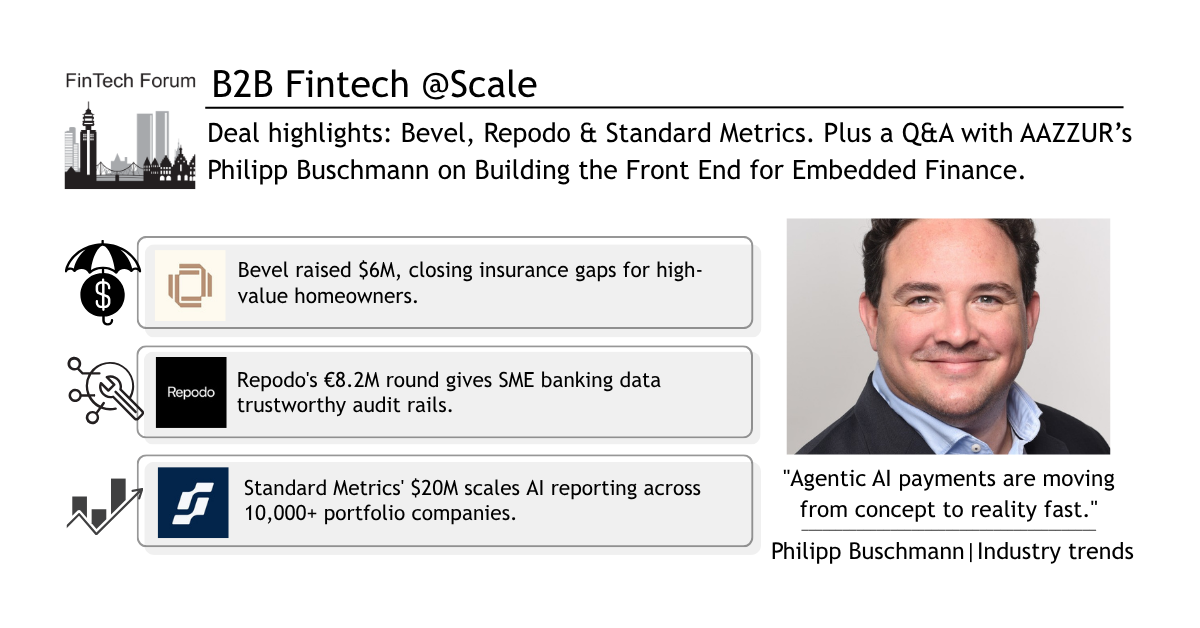
B2B FinTech @Scale Deal Highlights: Bevel, Repodo & Standard Metrics.
Samarth Shekhar highlights startups that can help scale financial services by unlocking new customer segments or product offerings via B2B partnerships.
Property is one of the largest assets held by HNWIs, but Bevel estimates 70% of the highest-value homes are underinsured. Having started offering free AI tools to help disaster survivors in California rebuild their personal-property inventories for insurance claims, it saw the pain lay in misfit insurance coverage. It builds a verified, AI-generated personal property inventory, identifies coverage gaps before a loss, identifies households whose sums insured are materially wrong, and offers them better-priced risk. An insurer can thus underwrite against an accurate, itemized schedule of contents rather than a self-declared estimate, becoming a “downside-risk counterpart to a wealth manager” for a lucrative customer segment.
Repodo is building a licensed audit firm and software, which can help banks get access to faster, cheaper, machine-readable statutory audits of SMEs current financial data- vs. their own credit underwriting and monitoring for a segment where financials are usually stale and manually prepared. On the other hand, banks can refer their business customers to a faster, lower cost audit, and get a data feed to underwrite more loans.
Standard Metrics as a system of record for private markets portfolio data enables automated ingestion, valuations, LP reporting, and diligence across 10,000+ portfolio companies and $400bn+ in assets. For a bank or insurer with a private markets allocation or a fund-of-funds business, it can help scale alternatives exposure without adding to their team. It can also help a private bank or asset manager can offer its clients richer, more transparent private markets reporting and add fund relationships.
Read on for more on the founders and investors in the news last week. If you are building or backing “what’s next in finance” and want to spread the word with our network of 20K+, reach out to Samarth Shekhar or Frank Schwab.
The best individual product is not necessarily the best enterprise decision.
by Frank Schwab
Enterprise software sourcing often begins with a sensible question:
Which product best meets our requirements?
Specialist products can offer deeper functionality, closer business fit and faster innovation. But choosing the strongest application in every category does not automatically produce the strongest enterprise technology environment.
Three considerations widen the decision:
- Portfolio economics extend beyond product price and implementation. Dependencies, interoperability, duplication, security and eventual replacement also matter.
- Enterprise value crosses application boundaries. Shared processes and data can be as important as the capability of any single product.
- Control creates a two-sided risk. More suppliers add governance obligations; greater consolidation can increase concentration and exit risk.
Read more: https://www.linkedin.com/feed/update/urn:li:activity:7498620427942957057/
VENTURE FINANCING
Exclusive: LA wildfire claims startup Bevel raises $6 million to expand into high-net-worth broking
Bevel, which built free AI tools to help disaster survivors rebuild their personal-property inventories for insurance claims, has raised $6 million and is expanding into a licensed high-net-worth insurance brokerage. The company’s tools — which use AI to scan photos or videos of a home, identify personal-property items, and estimate replacement values — were used by more than a quarter of Palisades and Eaton fire survivors, and are now being deployed with nonprofit partners in wildfires in Washington and Colorado. As the team dug into claims, founder Adam Freed said, it became clear the real problems existed before the disaster: “Ultimately, most people we served had misfit coverage. The larger the dwelling and risks, the more gaps we find. In fact, market estimates suggest that as many as 70% of the highest-value homes in America are underinsured.” Bevel is now building a licensed brokerage on the back of that work, aimed at high-net-worth households and pitching itself as the downside-risk counterpart to a family’s wealth manager. The commercial product will be limited to qualifying households, while the free tools for disaster survivors continue.
Ex-Lunar founders raise €8.2m to launch AI-native audit firm Repodo
Repodo, an authorised audit firm founded in Copenhagen, has raised €8.2 million ($9.5M) in pre-seed funding — reportedly Denmark’s largest pre-seed to date — to launch in Denmark before a broader European rollout. The round was led by Hedosophia (whose portfolio includes Monzo, Wise and Stripe) and Seed Capital, both prior backers of Lunar. The company was founded by Ken Villum Klausen, former CEO of Nordic digital bank Lunar, alongside Lunar’s former CFO Peter Andreasen and former CPO Joachim Strøjer Hansen, together with licensed auditor Anders Houmann — whose credentials allow the firm to issue statutory opinions. Repodo is building an AI-native operating model for statutory audit rather than adding AI tools to an established workflow: its platform automates data collection, reconciliations, documentation and transaction analysis, while qualified auditors retain responsibility for review, risk assessment, professional judgement and final sign-off. Crucially, Repodo is not selling software to existing practices — it is building the licensed firm and the software together, operating inside the regulatory perimeter. The European auditing market is projected at $74.3bn in 2026, with Deloitte, EY, KPMG and PwC collectively holding about 97%. Onboarding is slated for 2026 with an initial focus on SMEs.
Source: https://www.repodo.com/press/raises-pre-seed-funding
AI-Driven Portfolio Management Platform Standard Metrics Raises $20M to Supercharge Private Markets Innovation
SAN FRANCISCO, Aug. 24, 2026 /PRNewswire/ — Standard Metrics, the AI-driven portfolio management platform for venture capital and private equity, today announced it has raised $20M in Series B funding led by 8VC with participation from Salesforce Ventures, Spark Capital, January Capital, First Trust Capital Partners, Socii Capital, Kindergarten Ventures, Calm Ventures, Gaingels, and more. Standard Metrics launched in 2020 with a goal of fixing broken investor relations in the private markets, and has evolved into a single source of truth for portfolio performance and investment data. Automated data ingestion and AI-driven analysis and reporting tools help VC/PE firms streamline portfolio reviews, valuations, LP reporting, and diligence. The company has launched AI document parsing, an on-platform AI Analyst, MCP interoperability, and AI-native services to assist with data operations and portfolio analytics. Standard Metrics has grown its business approximately 20x since its Series A, and its platform supports more than 10,000 portfolio companies and 150 firms who manage over $400 billion in assets. Thirty percent of the current Forbes Midas List are customers, and investors like General Catalyst, Bessemer Venture Partners, and Accel use the platform. The capital will deepen its AI capabilities, expand the team, and bring the platform to more private-market investors.
Dubai-based Fasset raises $68M Series C at $1B valuation, only 3 months after previous round
[Middle East / South Asia corridor — out of core US-EU mandate, included on thesis relevance: emerging-market financial inclusion + cross-border remittance] Fasset, the stablecoin-powered digital banking platform, has raised a $68 million Series C led by Japan’s SBI Group at a $1 billion valuation, three months after closing a $51 million Series B; Speedinvest also participated, taking Fasset’s 2026 fundraising to $119 million. The company says it has been profitable for the past 12 months, with revenue up more than sixfold year on year. Annualised transaction volume has passed $40 billion across 125 countries, up from $32 billion in May, serving over 3 million wallets and 1,000 enterprises. Fasset provides accounts, payments and investment products for consumers and businesses, using stablecoins as settlement infrastructure beneath transactions between currencies, bank accounts and other assets, and uses AI to route transactions across rails, currencies, and liquidity providers by cost, speed and availability. It will expand Own Network — its regulated infrastructure connecting banks, telcos, and payment and liquidity providers across 100+ banking corridors — and works with SBI Remit on cross-border payments across the Morocco-to-Malaysia corridor. Founded in 2019 by Mohammad Raafi Hossain and Daniel Ahmed, Fasset became one of the first firms licensed by Dubai’s VARA in 2023 and has developed Shariah-compliant products built around stablecoins, gold, equities and sukuk. Hossain, announcing the round: “Your name, passport and birthplace still shape what money can reach you, where it can go and what it can become.”
Imprint lands $2B in debt as institutional demand for its card receivables jumps
Imprint, a New York co-brand credit card and loyalty platform, has secured $2 billion in new debt funding since April 2026 — the total spans $1.5 billion of incremental warehouse capacity and a $500 million AAA-rated asset-backed securitization. The warehouse expansion drew in Bank of Nova Scotia, Royal Bank of Canada, and TD Bank Group, with a further facility doubled from $500m to $1bn adding Citi alongside Mizuho, Truist, and HSBC. Imprint builds co-branded cards and loyalty programs for brands including Booking.com, H-E-B, and Shell. The August securitization, PRNT 2026-A, was upsized from $300 million to $500 million and drew $2.35 billion in investor orders — 4.7x coverage, versus 1.7x for Imprint’s debut ABS in October 2025. “In under a year, we’ve significantly grown our funding capacity, doubled our lending partners, and lowered our borrowing costs,” said Colin Groshong, CFO of Imprint. Deeper demand and better pricing signal that securitization is now a recurring part of Imprint’s funding strategy; at $2 billion, this ranks among the largest debt raises ever by a US fintech. As institutional investors line up for debt backed by card receivables, well-performing fintech lenders are finding cheaper, more diversified capital — a sharp contrast to the funding squeeze that hit the sector recently.
Source: https://fintech.global/2026/08/27/imprint-locks-in-2bn-as-lenders-bet-big-on-co-brand-cards/
Vanguard inks $4bn deal to acquire digital custodian Altruist
Vanguard has agreed to acquire Altruist, a digital wealth-management platform and custodian for independent financial advisors, in a deal valuing Altruist at approximately $4 billion. Launched by founder and CEO Jason Wenk in 2018, Altruist serves over 6,000 financial advisors through its self-clearing brokerage, providing solutions for fee billing, portfolio management and reporting, and account opening — plus an AI platform called Hazel, introduced in 2025 to automate client communications. Altruist’s technology and custody platform gives Vanguard a bigger foothold among independent financial advisers, putting it in closer competition with Schwab and Fidelity. Altruist will continue operating as a standalone business, retaining its current operating model, branding, and leadership; Vanguard, an Altruist investor since 2020, plans to become an anchor client. The deal aligns with a strategy under CEO Salim Ramji, who created a new advice and wealth-management division shortly after taking leadership in 2024: “Many investors in Vanguard funds choose to work with financial advisors, and far more people could benefit from access to financial advice than the industry can serve today.” Altruist last raised $152 million at a $1.9 billion valuation — Vanguard is paying roughly twice that. It is only the second acquisition in Vanguard’s 51-year history.
Source: https://www.fintechfutures.com/m-a/vanguard-to-acquire-altruist
If there’s a thread running through this week’s edition, it’s this: the builders worth watching aren’t waiting for permission. They’re rebuilding audit, insurance, and portfolio infrastructure from the inside — and the capital is following.
We’ll be back next week with more of the people, product decisions, and deals shaping where finance goes next. Until then, stay curious.