
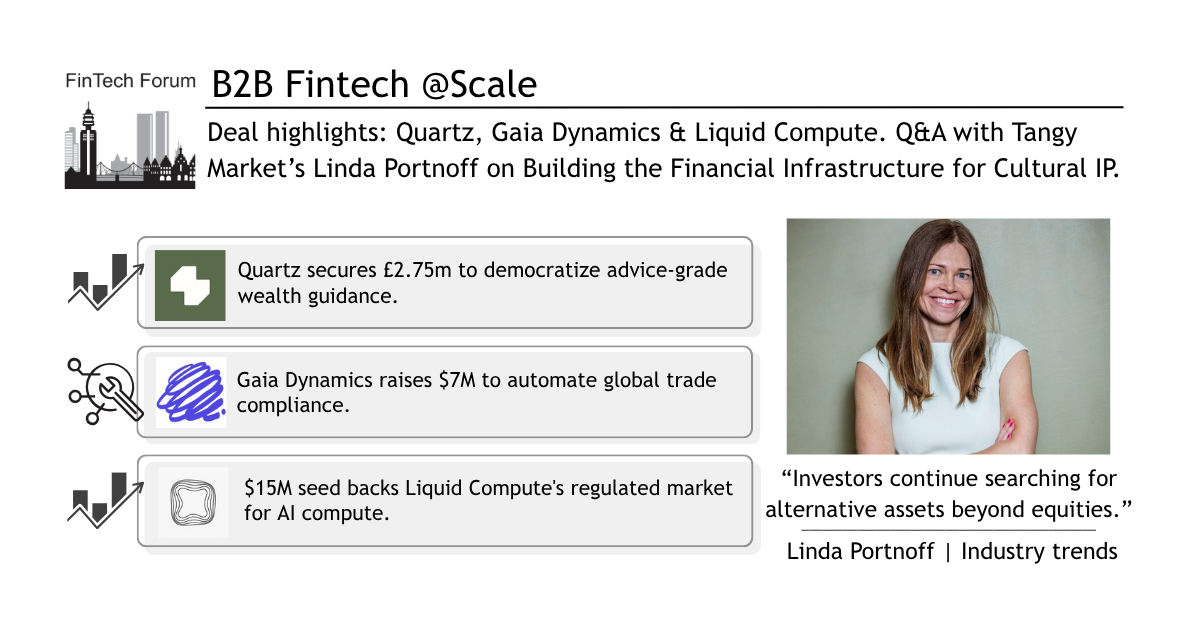
From the private catalogues of cultural IP to the ledgers of agentic AI, capital is finding its way into corners of the economy that didn’t have financial infrastructure a year ago. This week, Samarth Shekhar spotlights three startups doing exactly that — Quartz, Gaia Dynamics, and Liquid Compute — each unlocking a market that institutions couldn’t economically serve before.
Frank Schwab turns his eye to the operating ledger, tracing how agentic work is starting to show up not as a promise, but as a measurable line item. And in our Q&A of the week, Linda Portnoff of Tangy Market explains how she’s building the missing financial plumbing for a $45 billion royalty economy — turning your favorite playlist into an institutional asset class.
Round it all off with our weekly roundup of the companies raising the capital to build what’s next. Settle in — there’s a lot to unpack.
A Q&A with Linda Portnoff of Tangy Market on Building the Financial Infrastructure for Cultural IP

In the quiet transformation of streaming, music has become something far more powerful than entertainment: a predictable, global cash-flow engine generating roughly $45 billion in annual royalties. Yet for years, this asset class remained fragmented, illiquid, and largely inaccessible to institutional capital.
Enter Linda Portnoff, Founder & CEO of Tangy Market. With a PhD in Finance, a former role as CEO of Music Sweden, seven years on the board of STIM, and a background advising the Swedish government on the creative economy, Portnoff has spent her career at the precise intersection of intellectual property, music, and capital markets.
What she saw on the STIM board was both the opportunity and the gap: streaming had turned songs into reliable revenue streams, but the financial infrastructure to value, finance, and invest in them simply did not exist.
Today, Tangy Market is building that missing layer—proprietary AI-driven valuation, transaction infrastructure, rights administration, and marketplace technology—aimed squarely at institutional investors, family offices, and financial institutions seeking differentiated, income-generating alternatives. Music is only the starting point; gaming and other cultural IP categories are next.
In this Q&A, Portnoff shares how Tangy Market is turning cultural intellectual property into a legitimate institutional asset class—and why the next chapter of finance may sound a lot like your favorite playlist.
1. Tell us about yourself / your co-founder(s).
I’m Linda Portnoff, Founder & CEO of Tangy Market. I hold a PhD in Finance and have spent my career at the intersection of intellectual property, music and capital markets. Before founding Tangy Market, I was CEO of Music Sweden, served seven years on the board of STIM (the Swedish collecting society), and advised the Swedish government on the creative economy.
While serving on STIM’s board, I saw streaming transform music into a predictable global cash flow—but there was still no financial infrastructure for valuing, financing or investing in these assets.
To solve that, we’ve built a team spanning capital markets, regulation, AI and rights management, including former executives from Skandia, Nordic Growth Market, Embracer, Starbreeze and Electronic Arts.
Read more from the interview: Building the Financial Infrastructure for Cultural IP
B2B FinTech @Scale Deal Highlights: Quartz, Gaia Dynamics & Liquid Compute.
Samarth Shekhar highlights startups that can help scale financial services by unlocking new customer segments or product offerings via B2B partnerships.
Quartz: Wealth guidance has long been split between costly personalised advice for the rich and standardised products with little guidance for everyone else, leaving the UK mass-affluent- millions of people with pensions, ISAs and scattered investment accounts- underserved despite holding meaningful assets. Quartz aggregates everything a person owns (pensions and brokerage accounts, via its own FCA-registered AISP connectivity) and layers an AI assistant, Charlie, that learns a user’s goals and monitors markets on their behalf.
A bank or wealth manager can embed Quartz’s aggregation-plus-AI layer to offer advice-grade guidance to the mass-affluent segment it cannot economically serve with human advisers, deepening the deposit and investment relationship without building the aggregation or AI infrastructure itself.
Gaia Dynamics: Global trade runs on more than $20tn a year of goods whose duties, classifications and customs filings still get managed on spreadsheets and periodic manual reviews, just as tariff volatility and enforcement are rising sharply and qualified trade professionals are in short supply. Gaia Dynamics is an AI trade-compliance platform- the first AI to pass three consecutive US Customs Broker License Exams- that handles HS classification, tariff calculation, entry audits and compliance across 48 countries.
A bank with a trade-finance business, or an insurer writing trade-credit and cargo cover, can plug into Gaia to price and underwrite cross-border risk on accurate, real-time classification and duty data, turning a manual bottleneck into an embedded capability that supports faster, cleaner trade-finance origination.
Liquid Compute: Compute has become one of the economy’s most valuable inputs, yet capacity is heterogeneous, location-dependent and perishable, and there is no transparent market layer to price, trade or hedge it- closer to an unbuilt power grid than a functioning commodity market. Liquid Compute is building CFTC-regulated venues to trade and settle compute capacity, with a physical orderbook plus pricing and market data, and trading partnerships already signed with Susquehanna, BGC Group and Wintermute.
For a bank’s markets desk or a commodity-trading operation, Liquid Compute opens a new tradable asset class- spot and, pending regulatory approval, derivatives on compute- through familiar exchange and clearing infrastructure, while its price index gives lenders and insurers a reference to underwrite and hedge the data-centre and AI-infrastructure financing they are increasingly exposed to.
Read on for more on the founders and investors in the news last week. If you are building or backing “what’s next in finance” and want to spread the word with our network of 20K+, reach out to Samarth Shekhar or Frank Schwab.
Agentic Work Enters the Operating Ledger
by Frank Schwab
Agentic AI is moving from product claims into measurable economic capacity, with machine work now appearing in operating and revenue metrics. OpenAI counts agent-workdays, Salesforce counts billions of work units, and Adobe reports AI-first recurring revenue, but comparable outcomes, safe long-horizon performance, and scalable unit economics remain unproven.
The Work Now Within Reach – OpenAI reported more than one billion weekly active users and 2.5 million business customers across its consumer, enterprise, and developer products. Inside its research organization, production agents generated 3.1 agent-workdays of effort for every human workday while people retained responsibility for priorities and evaluation.
Read more: https://www.linkedin.com/pulse/agentic-work-enters-operating-ledger-frank-schwab-qadhf/
VENTURE FINANCING
Quartz raises £2.75m pre-seed for AI-led wealth platform
Quartz, a UK-based wealth platform that brings together everything a person owns and pairs it with an AI assistant to deliver personalised financial guidance, has launched in the UK after securing £2.75m in pre-seed funding. The round was led by Daphni, with participation from Outward VC and K Fund, alongside a group of angel investors including Kantox founder Philippe Gelis and former N26 and Kraken chief product officer Gilles BianRosa. The company has been testing its platform since the beginning of the year, and more than £10m of its members’ assets are already being tracked. Quartz was founded to close a long-standing gap in wealth management, where consumers have traditionally had to choose between costly, personalised advice or standardised products offering little guidance. The company’s co-founder, André Silva, who previously led global expansion at Revolut, said that while millions of people gained access to fast, transparent banking, the more valuable guidance needed to grow their money remained expensive and largely limited to wealthy clients. At the core of Quartz’s offering is its own aggregation technology for pensions and brokerage accounts, built in-house over the past year. The company has registered with the UK Financial Conduct Authority as an Account Information Service Provider, allowing it to securely connect to customers’ pensions, ISAs, savings and investment accounts, with permission. Layered on top of this is Charlie, an AI-based assistant designed to learn a user’s goals, monitor markets on their behalf, and surface relevant information at the right time.
Source: https://fintech.global/2026/09/17/quartz-raises-2-75m-pre-seed-for-ai-led-wealth-platform/
Gaia Dynamics Raises $7M to Expand AI Platform, Keeping Businesses Ahead of Tariffs and Trade Risk
PALO ALTO, Calif., Sept. 16, 2026 /PRNewswire/ — Gaia Dynamics, the leading AI-powered trade compliance platform, today announced the close of an oversubscribed $7 million seed round led by Corazon Capital, with participation from Lobby Capital and continued backing from existing investors Andrew Ng’s AI Fund and Zenda Capital. (A related SEC Form D reports the offering at $8.59M.) The funding comes as trade rules are becoming more complex amid rapid regulatory changes; customs authorities are increasing enforcement, raising the cost and risk of errors; and businesses face a shortage of qualified professionals able to manage the growing volume, complexity, and exposure. Since launching in late 2024, Gaia has become the first AI application to ace three consecutive U.S. Customs Broker License Examinations, enabling importers, exporters, logistics providers, and trade professionals with a purpose-built platform that helps perform Harmonized System classification, calculate tariffs, improve product data, audit customs entries, and manage compliance across 48 countries. “Global trade is changing too quickly for companies to manage it through disconnected systems, spreadsheets, and periodic reviews,” said Emil Stefanutti, co-founder and CEO. Gaia will use the funding to expand its team and introduce new AI capabilities for strategic trade planning and compliance before year-end.
Liquid Compute Launches with $15M to Build a Regulated Exchange for AI Infrastructure
NEW YORK, September 15, 2026 (BUSINESS WIRE) — Liquid Compute, a marketplace company building regulated venues for trading AI infrastructure, today emerged from stealth with $15 million in seed funding co-led by FirstMark and Chemistry, with participation from K8 Capital, Night Capital, TrueBridge, Brainchild Holdings, UFO Holdings, and angel Dmitry Balyasny. Founded by Ronit Jain and Aarav Patel, Liquid Compute (formerly Pluto) is a Y Combinator (W24) company. The founders met as engineering students at UC Berkeley and came to believe that compute should be organized more like a power grid than a conventional commodity market like oil. Capacity is heterogeneous, location-dependent, and perishable, making the central challenge one of matching supply and demand across time, geography, and infrastructure. Liquid Compute is building a market layer that connects this fragmented physical capacity into a more transparent and standardized compute grid, and has applications pending before the CFTC for Designated Contract Market and Derivatives Clearing Organization status. The company has signed trading and data-licensing partnerships with Susquehanna, BGC Group, and Wintermute. On top of the physical orderbook, Liquid Compute is developing transparent pricing and market data that gives buyers, sellers, traders, and lenders a clearer view of how the industry prices capacity, underwrites infrastructure, manages risk, and allocates capital.
Ryft raises £20m in Manchester-led funding round
Ryft, a Manchester-based payments-infrastructure firm, has closed a £20 million Series B round led by Gresham House Ventures, with follow-on support from existing backers Pembroke VCT and Ingenii Capital, and NPIF II-PXN Equity Finance from the Northern Powerhouse Investment Fund II. Several reports describe the deal as the largest Series B completed by a UK payments company in 2026; valuation was not disclosed. Founded in 2021 by Sadra Hosseini, Alex Mackenzie and Richard Kirby, Ryft (regulated by the FCA as authorised payment institution Ryft Pay Ltd) sells payment systems to marketplaces, platforms and multi-location businesses. It plugs into acquiring banks and gives them the tools to split a payment, hold part of it in escrow, and pay out multiple parties on different schedules, all through a single integration — for example, a marketplace selling tickets on behalf of hundreds of independent promoters can take its commission at checkout, hold the rest until the event, then pay each promoter automatically. More than 6,500 businesses now use the platform, including Epos Now, Chaiiwala, the Disasters Emergency Committee, Daytrip and Sprive, and processing volume tripled over the past year. The company has applied for a full payment-institution licence from the Malta Financial Services Authority to unlock EU operations, and the capital will fund expansion across Europe and the US. Total funding now stands at roughly £27.4m.
Source: https://cfotech.news/story/ryft-raises-gbp-20m-in-manchester-led-funding-round
AIUC raises $40M Series A from Ribbit & First Harmonic to build confidence infrastructure for frontier AI
SAN FRANCISCO, Sept. 15, 2026 /PRNewswire/ — Artificial Intelligence Underwriting Company (AIUC) has raised a $40 million Series A led by Ribbit Capital, with participation from First Harmonic. Alongside its $15 million seed led by NFDG, the round brings its total funding to $55 million. Risk, not capability, is becoming the binding constraint on AI adoption. Waymos are superhuman drivers, yet Waymos aren’t allowed in most places because the risk is hard to understand. In short, there’s a confidence gap: enterprises and the public cannot use an AI system they cannot trust, and this problem gets more acute as agents get smarter. Artificial Intelligence Underwriting Company has developed AIUC-1, the industry-driven standard for AI agents. Certification means running an agent through roughly 5,000 combinations of risk and attack tailored to the type of business deploying it — testing for jailbreaks, hallucinations, prompt injection, and data leaks — backed by quarterly audits. By partnering with Lloyd’s of London, AIUC provides insurance coverage for AI agents, putting capital behind its certification; the AIUC-1 standard is already used to certify agents including Cursor, ElevenLabs, Fin, Harvey, KPMG, Lovable, and UiPath. Co-founders Rune Kvist (Anthropic’s first product hire) and Rajiv Dattani (former McKinsey insurance partner, ex-COO of METR) frame the model on a historical analogy: “When electricity was burning down houses, the insurers paying the bill funded Underwriters Laboratories to test and certify products. To this day, the UL mark is on most light bulbs across America. AI needs the same combination of standards, testing and insurance.”
Captive platform Luzern Risk raises $45 million in Insight Partners-led Series B
Luzern Risk has secured $45 million in a Series B round, led by Insight Partners, the full-service captive manager announced on Thursday. Other participants included Trust Ventures and existing investor Caffeinated Capital, which had led the company’s seed round in 2023 and its $12 million Series A round in 2025. The new capital will be used to advance the development of its platform and continue to build its AI capabilities. It will also bolster operational strength by systemizing operations across the business, reducing turnaround times for work that is often complex and specialized, and provide clients with additional options across the alternative risk value chain. New York-based Luzern Risk, formerly XN Captive, was founded in 2023 and specialises in alternative risk solutions. Its AI-native technology platform is built to significantly compress the time required to launch and administer custom captive programs at scale. As commercial insurance becomes increasingly costly and volatile, risk-conscious organizations are seeking greater control over how their exposures are financed. Captives — regulated insurance entities owned by the parent organization — convert unpredictable expenses into strategic assets by offering the ability to write bespoke coverage, retain underwriting profit, and accumulate surplus.
Velocity raises $48M Series A with Visa, Circle and Ripple
London-based Velocity has added $10 million to its Series A, bringing the round to $48 million after a group of traditional finance and crypto investors joined the raise. Visa Ventures, Circle Ventures and Ripple participated alongside Haun Ventures, Translink Capital and Mirana Ventures, according to the company’s announcement. The extension values the firm at $200 million post-money, CEO Eric Queathem said. The capital arrives only weeks after Velocity disclosed a $38 million Series A in July, a round led by Dragonfly and FirstMark. The company, founded in 2025, is building backend systems that let banks, payment processors, card issuers, acquirers and merchants use stablecoins for settlement, liquidity management and treasury work without discarding the software and banking connections they already run. Velocity presents itself as a connector rather than a replacement layer: institutions keep their current systems, and its public materials state that digital-asset conversion and related controls are performed by licensed partners. Velocity said the combined $48 million will go toward expanding the platform and working more deeply with issuers, acquirers, merchants and financial institutions.
Model ML raises $125M Series B (reported)
Model ML, the global AI workflow automation platform for financial services, has raised a new round reported at $125 million. Bloomberg reported the company was in talks to raise more than $100 million at a valuation above $1 billion, with the size potentially reaching $150 million depending on investor interest; PitchBook logs the round at $125 million. The raise follows the company’s $75 million Series A (November 2025, led by FT Partners, one of the largest FinTech Series A rounds on record) and a strategic investment from HSBC Asset Management in August 2026, which brought total funding above $100 million. Founded in 2023 by brothers and repeat entrepreneurs Chaz and Arnie Englander, Model ML enables financial teams to build AI workflows that automatically generate client-ready Word, PowerPoint and Excel outputs directly from trusted data in exact prior formats. The platform is deployed across several of the world’s largest banks, asset managers and consultancies, including two of the Big Four accounting firms. Its agent workflows go beyond simple data retrieval or chat interfaces: they interpret schemas, reason across multiple sources, write code to extract and transform data, and generate full branded outputs such as long PowerPoint decks, diligence reports and investment memos, with verification built in. [Round reported by Bloomberg and logged by PitchBook; a formal press release for the $125M close was not located at time of writing — figure to be confirmed.]
Angle Health Raises $600 Million at a $2.7 Billion Valuation to Continue Expanding Affordable Healthcare Access for Small Businesses
SAN FRANCISCO — Angle Health, the first AI-native healthcare benefits platform, today announced a $600 million equity financing at a $2.7 billion valuation, consisting of a $200 million Series C financing and a $400 million tender offer. The round, led by Vitruvian Partners with participation from new investor Town Hall Ventures and existing investors Blumberg Capital, Portage Ventures, PruVen Capital, and Y Combinator, is expected to close later this month. Since launching in 2021, Angle Health has emerged as the leading alternative to traditional health insurance plans for small businesses nationwide, now serving more than 5,000 employers, offering customized health plans in 47 states, and delivering four consecutive quarters of profitability. The announcement comes at a time when employers are facing the largest increase in health insurance costs in two decades. Small and midsize businesses are hit especially hard, with limited options that are costly, confusing, and difficult for employees to navigate, or simply unaffordable. Angle said its median year-over-year renewal increases have recently ranged between 5% and 7%, compared with a median increase of approximately 18% for small and midsize businesses, and it has introduced care delivery programs intended to lower costs across expensive categories such as specialty medications, infusions, outpatient surgery and radiology. “Access to great healthcare shouldn’t depend on the size of the company you work for,” said Ty Wang, co-founder and CEO of Angle Health.
S&P Global to Acquire Smart Contract Security Firm OpenZeppelin
S&P Global has agreed to acquire OpenZeppelin, the smart-contract security firm whose open-source libraries and audits have underpinned an estimated $37 trillion in onchain value transfers since 2015. The deal, announced September 17, 2026, expands the financial data, ratings and benchmark provider’s digital-asset capabilities; financial terms were not disclosed and the transaction remains subject to closing conditions. OpenZeppelin will join S&P Global Ratings and operate as a separate business unit under the same name, with co-founder Demian Brener remaining CEO and reporting to Yann Le Pallec, President of S&P Global Ratings. OpenZeppelin, founded in 2015, develops open-source smart-contract software and has performed more than 900 security engagements for protocols and institutions, discovering and helping resolve over 10,000 potential security weaknesses before deployment. Its Contracts libraries will remain open source, free and publicly maintained on GitHub. The acquisition gives S&P outright ownership of one of the standards bodies institutions already rely on to vet the smart contracts underlying tokenized products, positioning the company to sell risk assessment across both the data and code layers of onchain markets. It follows S&P Global Ventures’ strategic investment three days earlier extending crypto data provider Kaiko’s Series B to $110 million — together signalling a broader risk-assessment stack spanning market data, stablecoin ratings, and now smart-contract security as capital markets move onchain. FT Partners advised OpenZeppelin; Jefferies advised S&P Global.
Source: https://www.blockhead.co/2026/09/18/s-p-global-to-acquire-smart-contract-security-firm-openzeppelin/
That’s a wrap on this week’s edition — but the story is only getting started. From wealth guidance for the mass-affluent to a regulated market for compute itself, this week’s founders are proof that the next great financial infrastructure is rarely built where anyone expects.
As always, thank you for reading, for sharing, and for being part of the 20,000+ minds shaping what’s next in finance. If you’re building — or backing — the future we’ve written about today, we want to hear from you.