
This week, we’re tracking the quiet infrastructure shifts that will define who wins the next decade of financial services.
In our Q&A, OneAM’s Ksusha McCormick makes the case for reinventing SMB working capital — turning decades of fixed-income pricing discipline into a sharper, fairer way to underwrite the businesses banks have long overlooked.
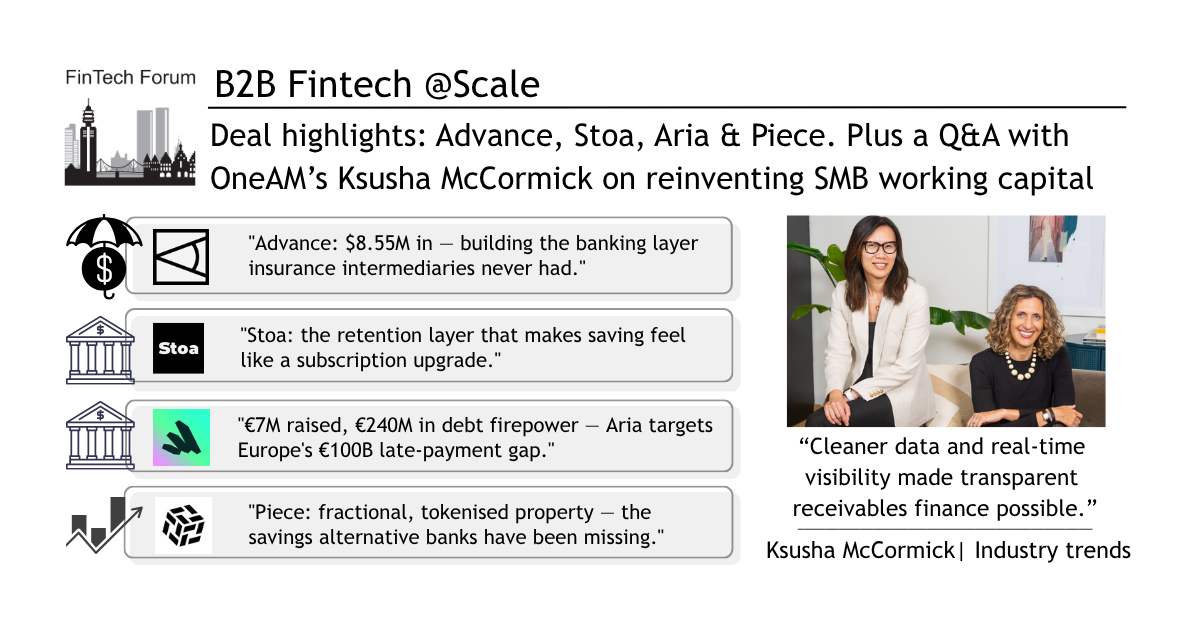
Samarth Shekhar zeroes in on four companies rewriting the rules of B2B partnerships: Advance, Stoa, Aria, and Piece are each turning an operational blind spot — idle premium float, dormant savings, late payments, illiquid real estate — into a new revenue line for the institutions willing to partner with them.
Frank Schwab looks at what happens when a retail crypto exchange becomes infrastructure for AI agents, as Revolut X opens its rails to autonomous assistants like Claude, Gemini, and Cursor.
And in Venture Financing, we round up the capital moving into the sector this week — from insurance-focused banking infrastructure to sovereign bonds issued natively onchain.
Let’s get into it.
A Q&A with OneAM’s Ksusha McCormick on reinventing SMB working capital

Pictured: Charlotte Ng (left) and Ksusha McCormick (right)
In a landscape where small and midsize businesses move faster than the financial infrastructure meant to support them, OneAM is betting on a smarter, more transparent approach to working capital. Co-founders Ksusha McCormick and Charlotte Ng bring a unlikely blend of quantitative finance, payments innovation, and product strategy — a combination that feels tailor-made for this moment.
In this week’s Q&A, they unpack how cleaner data, modern underwriting, and shifting institutional appetite are finally creating the conditions to reinvent a space that has resisted change for decades.
1- Tell us a bit about yourself, and how you got the idea for your company.
I’ve spent most of my career in fixed income pricing and risk — from trading FX and interest rate derivatives at Morgan Stanley to portfolio management at a hedge fund, to later leading a fixed income pricing and risk analytics provider called Decameron Technologies. Across much of it, the throughline has been the same: making use of heterogeneous data and identifying models that make risk easier to understand, price, and manage.
When I met Charlotte, everything clicked. She approached financial risk from the perspective of using technology to improve access to fairly priced financial products — and possessed deep experience in new product development that leveraged the two-sided payment network, operational rails, and trusted infrastructure of Mastercard. As we compared notes, it became clear that the lessons we learned on our respective paths could be applicable to building a radically better solution for the working capital problem faced by small and midsize businesses.
Read more from the interview here: Inside the next wave of receivables finance
B2B FinTech @Scale Deal Highlights: Advance, Stoa, Aria & Piece.
Samarth Shekhar highlights startups that can help scale financial services by unlocking new customer segments or product offerings via B2B partnerships.
Insurance intermediaries — MGAs, wholesalers, and agencies — currently use generic business banking to manage premium trust accounts, meaning fiduciary float sits idle and reconciliation is manual. Advance turns that into a revenue line by building tailored banking infrastructure that earns yield on segregated premium balances while automating collection, remittance, and compliance workflows. Carriers can white-label Advance’s infrastructure to their MGA panel, creating a new fee-sharing revenue stream. They can become the financial infrastructure layer for their distribution chain, not just the risk-taker at the end of it.
Stoa converts savings deposits into prepaid lifestyle benefits, rewarding depositors with subscriptions and experiences rather than interest. Think of the under-35 mass-market consumer who doesn’t respond to traditional savings products because the reward is invisible and deferred. For a bank or insurer with a savings book under pressure from higher-yield alternatives, Stoa can become the white-labeled retention layer that takes the product from “earn 3% APY” to “save £200/month and get your gym, streaming, and commute covered.” It also creates a spending behaviour data asset directly useful for cross-selling insurance and lending products.
European SMEs are owed an estimated €100 billion in late payments at any given time, concentrated in asset-light, digitally native companies that banks struggle to serve with traditional credit products. Aria‘s embedded invoice financing API sits inside the marketplace or ERP where the transaction happens, advancing payment to suppliers instantly while buyers retain standard 60-day terms. For a bank with supply chain or trade finance ambitions, Aria is an origination layer that routes SME financing at the moment of invoice approval – a segment the bank’s branch network could never reach efficiently – while delivering a performing loan book at a 0.1% default rate.
Piece tokenises income-producing European real estate into fractional digital securities, letting retail investors access a diversified property portfolio from a few hundred euros. The European mass affluent saver has always been told real estate is the best long-term asset but has had no regulated, low-minimum way to access it. For a bank or insurer with a wealth or savings arm, distributing Piece‘s tokenised units as a savings alternative could help create a differentiated product without having to originate or manage properties.
Read on for more on the founders and investors in the news last week. If you are building or backing “what’s next in finance” and want to spread the word with our network of 20K+, reach out to Samarth Shekhar or Frank Schwab.
Banking for Bots: How Revolut Turned Its Crypto Exchange into an AI Infrastructure Layer
by Frank Schwab
Revolut made a major move directly at the intersection of retail finance and the agentic economy by officially connecting its standalone crypto exchange, Revolut X, to third-party autonomous AI assistants (including Claude, Gemini, and Cursor).
This integration transitions Revolut X from a standard user-facing trading app into an open infrastructure layer for autonomous software.
Read more: https://www.linkedin.com/feed/update/urn:li:activity:7481946700673261568/
VENTURE FINANCING
FinTech, Advance, Raises $8.55M to Turn Insurance Payments into Revenue
NEW YORK, February 5, 2026 /PRNewswire/ — Advance, a financial platform built for insurance that reduces operational friction while ensuring premium dollars are controlled and earning, today announced it has raised $8.55 million in seed funding to modernize how insurance intermediaries manage and move money. The round was led by nvp Capital, with participation from Crystal Ventures, Vesey Ventures, and Mensch Capital, alongside strategic angels including Assaf Wand, former CEO and founder of Hippo Insurance. Insurance intermediaries — including managing general agents (MGAs), wholesalers, and scaled agencies — handle some of the most complex money movement in financial services. Premium dollars must be collected, segregated, reconciled, and remitted across multiple parties, all while maintaining strict compliance and auditability in support of their fiduciary responsibilities. Yet most firms still rely on general-purpose banking and payment tools that were never designed for these workflows. Advance is rebuilding the foundation, not layering software on top of the problem.
Paris-based Aria raises €7 million and launches €240 million debt facility to tackle Europe’s late-payment crisis
Aria, a Paris-based FinTech scale-up offering an embedded invoice financing platform that helps businesses get paid on time, has raised a €7 million Series A extension round and launched a €240 million debt facility to scale its financing capacity. The equity round was led by 115K, the venture capital arm of La Banque Postale, with participation from returning investor 13books Capital, and brings Aria’s total Series A to €22 million. 115K will join Aria’s board. The company plans to use this capital to invest in AI tooling, fund new hires, and onboard new clients. The debt facility is structured across two vehicles: a securitisation fund led by Nomura and a second legal vehicle with Sienna and Montpensier Arbevel. The scale-up financed 1.7 million invoice advances in 2025 and over 1.1 million more so far in 2026. It currently powers more than 70 of Europe’s largest B2B marketplaces and freelance platforms, including Malt and Job&Talent. Since launching in 2020, Aria has financed more than €1.5 billion in invoices, while maintaining a default rate below 0.1%.
M1X Global Announces Further Funding Led by Paradigm, Totalling $8.5 Million
NEW YORK, July 7, 2026 /PRNewswire/ — M1X Global, a sovereign financial infrastructure and technology company helping governments bridge the transition to 24/7, programmable capital markets, today announced the close of a Seed funding round just 14 weeks after its public launch and angel raise. The oversubscribed round was led by Paradigm, with strategic participation from Breed VC, and brings M1X Global’s total funding to $8.5 million. M1X Global worked with the Republic of the Marshall Islands to issue USDM1, the first USD-denominated sovereign bond natively issued on a public blockchain, secured 1:1 by short-duration US Treasuries and governed by New York law. Institutional availability includes offerings through Anchorage Digital’s federally regulated bank and tZERO’s SEC-registered broker-dealer custodian. The round follows a $3 million angel round that included Balaji Srinivasan (former Coinbase CTO), Tama Churchouse (Cumberland Labs CEO), and Peter Dittus (former Secretary General of the BIS). Paradigm partner Arjun Balaji: “24/7 markets require collateral that can move 24/7. USDM1 shows how sovereign debt can be issued natively onchain.”
Adaptive Insurance Closes Additional $5M Financing to Expand Specialty Insurance Products Addressing Emerging Risks
AUSTIN, Texas, July 7, 2026 (GLOBE NEWSWIRE) — Adaptive Insurance, the climate resilience company building AI-driven specialty insurance and technology solutions, today announced the close of an additional $5 million in financing from new and existing investors, bringing its total funding to $10 million. The financing includes participation from new investors IAG Firemark Ventures, Sunna Ventures, Room & Pillar, and Connecticut Innovations, alongside existing backers Congruent Ventures and Seraphim Space. The company’s growing product suite includes GridProtect, the first parametric insurance for short-duration power outages; Wind and Hail Deductible Buy-Back for residential and commercial properties; residential flood insurance offering broader coverage and higher limits than the NFIP; and Commercial Equipment Breakdown coverage. Adaptive also powers Tokio Marine HCC’s Restaurant Recovery program through its proprietary technology platform. The funding will support expansion of its specialty product portfolio, growth of its agent and partner distribution network, and continued development of its proprietary climate intelligence platform.
SA’s Bridgement Bags $20.3M To Bring AI-Driven Business Lending To More SMEs
South African fintech Bridgement has raised R330 million ($20.3 million) in funding from Rand Merchant Bank (RMB) and Standard Bank, strengthening its capacity to lend to small and medium-sized businesses while highlighting a growing partnership between traditional banks and AI-driven lenders. The capital will help Bridgement expand its loan book at a time when access to finance remains one of the biggest obstacles facing South African SMEs. SMEs contribute about 40% of South Africa’s GDP and account for roughly 60% of employment, yet many still find it difficult to secure credit because they lack audited financial statements, significant collateral, or the predictable cash flows that traditional lending models typically require. Industry estimates place the country’s unmet SME funding demand at between R350 billion and R386 billion. Founded in 2016 by CEO Daniel Goldberg, Bridgement has built its lending platform around live financial data rather than historical records alone, connecting to business bank accounts and accounting software such as Xero and Sage. Since launch, the company has provided more than R2 billion in financing to South African businesses. The company also plans to license its AI-powered credit technology to banks and corporates.
Source: https://techbuild.africa/bridgement-20-3m-ai-driven-business-lending-smes/
Innovation is rarely a straight line. It is a continuous loop of identifying friction, building smarter infrastructure, and having the courage to challenge legacy systems. The founders, analysts, and investors featured in this issue remind us that the future of finance is not a distant destination—it is actively being coded, funded, and scaled by people who refuse to accept the status quo.
As you step into the week ahead, we challenge you to look at your own corner of the ecosystem with fresh eyes. Where can friction be turned into fuel? Who can you partner with to unlock the next frontier?
Thank you for being an essential part of our 20,000+ strong community of builders, thinkers, and leaders. Until next week, keep pushing the boundaries.